

KYC matters for small businesses because it prevents fraud, keeps you inside AML rules that regulators actively enforce, protects the bank accounts you depend on to operate, and signals to customers and partners that you run a serious operation. Skip it, and you risk absorbing fraud losses your margins can’t cover, triggering a bank review that freezes your accounts, or losing a deal because a partner’s compliance team flagged your onboarding as too thin. Getting it right doesn’t require a legal department. It requires a few deliberate habits, applied consistently.
- Fraud losses stay contained because you know who you’re actually transacting with before money moves.
- Your bank accounts stay open because you can answer a due-diligence request the day it lands, not three weeks later.
- Customers and partners trust the relationship because your onboarding looks like it belongs to a business built to last.
The rest of this piece walks through what KYC actually involves, when it’s required versus simply smart, and how to build a program that fits a small team’s budget and bandwidth.
Key Takeaways
KYC works because it turns identity verification into a repeatable business control that prevents fraud, satisfies regulators, and keeps banking relationships intact.
| Point | Details |
|---|---|
| Start with CIP and CDD | Collect basic identifying information and assess customer risk before deeper scrutiny is ever needed. |
| Fraud losses hit small margins hardest | The FTC recorded $12.5 billion in reported fraud losses in 2024, a trend small businesses can’t absorb passively. |
| Banking relationships depend on documentation | OCC guidance confirms banks reduce or close accounts when due-diligence expectations go unmet. |
| Build a risk-based, not maximal, program | Match verification depth to actual risk tier instead of applying the same scrutiny to every customer. |
| Consider a specialized verification vendor | DAON offers biometric-grade identity verification that scales with a small business’s growing volume. |
This article is general information, not a substitute for advice from a qualified financial advisor. Consult a qualified financial professional about your own circumstances before acting on anything here.
Table of Contents
- What KYC Actually Means for a Small Business
- Why KYC Matters for Small Businesses Specifically
- Who Needs KYC and When to Start
- A Risk-Based KYC Checklist Small Teams Can Actually Run
- What Regulators Actually Expect (And Where to Check)
- Common KYC Challenges Small Businesses Run Into
- KYC Technology Small Businesses Can Actually Use
- How KYC Pays Off Beyond Compliance
- What Proper KYC Actually Changes on the Ground
- Sources
- FAQ
What KYC Actually Means for a Small Business
KYC stands for “know your customer,” and it’s the identity verification backbone of anti-money-laundering (AML) and counter-terrorist-financing (CFT) rules. The idea is straightforward: you can’t manage the risk of who you do business with if you don’t first confirm who they are. For a small business, that boils down to three linked practices.
- Customer Identification Program (CIP). This is the collection step. You gather a legal name, date of birth, address, and a government-issued ID number, then verify that the person or entity is who they claim to be. A landscaping company opening a business checking account will go through a bank’s CIP before the account is approved.
- Customer Due Diligence (CDD). This is the risk-assessment step. Once you know who a customer is, you assess how risky they are, factoring in their business type, transaction volume, and geography. FinCEN’s CDD final rule requires covered financial entities to verify beneficial ownership as part of this process, meaning you identify the actual humans who own or control a business customer, not just the entity name on a contract.
- Enhanced Due Diligence (EDD). This kicks in for higher-risk relationships: customers from high-risk jurisdictions, cash-intensive businesses, or anyone flagged by a sanctions or politically exposed person (PEP) screen. EDD means more documentation and more frequent review.
Recordkeeping ties it together. Keep copies of the ID documents you collected, the risk rating you assigned, and any screening results, for at least five years in most regulated contexts. Banks may ask for articles of incorporation and beneficial-owner declarations whenever your ownership structure changes, so update your file rather than waiting for a request.
Pro Tip: Store your KYC records separately from general business files. When a bank or auditor asks for documentation, being able to produce it in minutes, not days, is itself a trust signal.
Why KYC Matters for Small Businesses Specifically
A large enterprise can absorb a bad month of chargebacks. A five-person business usually can’t. That asymmetry is the real reason KYC compliance for startups and small firms carries more weight than the paperwork suggests.
Identity fraud and account takeover hit thin margins hardest. When a fraudster opens an account with a stolen identity and runs a handful of transactions before disappearing, a small business eats the chargeback, the processing fees, and often a card-network penalty on top. The FTC reported a sharp jump in total fraud losses reported by consumers and businesses in 2024, reaching $12.5 billion, up from prior years. That trend line points one direction, and small businesses without verification controls sit closest to the exposure.
Regulatory consequences compound the damage. Enforcement isn’t reserved for Wall Street. The TD Bank case demonstrates how far regulators will go when due diligence fails at scale, including large penalties and compliance oversight. Smaller firms face proportionally smaller fines, but the reputational hit and legal fees land just as hard on a limited budget.
Banking relationships are the quiet risk most owners underestimate. Banks run their own KYC on you as a customer, and OCC supervisory guidance makes clear that banks reduce or terminate relationships when a business can’t satisfy ongoing due-diligence expectations. That means:
- Delayed wire transfers while the bank asks follow-up questions
- Frozen accounts pending a risk review
- Outright account closure with limited notice
Beyond defense, KYC is a growth lever. Investors, payment processors, and enterprise partners increasingly ask for evidence of a compliance program before signing. A documented KYC process, even a lean one, answers that question before it’s asked.
Who Needs KYC and When to Start
Financial institutions, money transmitters, and virtual asset businesses face mandatory KYC under federal law, full stop. Most other small businesses fall into a different category: KYC isn’t legally required for the business itself, but it becomes practically unavoidable the moment you touch a bank, a payment processor, or an investor with their own compliance obligations.
Banks apply CIP the day you open an account, and they escalate to fuller CDD when your transaction pattern changes. Certain triggers should push any small business to tighten its own checks, even without a regulatory mandate:
- Onboarding a new owner or investor, especially one holding 25% or more of the equity
- Expanding into cross-border sales or accepting international payments
- Noticing transaction patterns that don’t match your typical customer (unusually large orders, rapid account activity, mismatched billing and shipping identities)
- Being asked directly by your bank or processor for updated beneficial-ownership documentation
If any of those apply, the practical answer isn’t “wait for a law to require it.” It’s “start now, at a scale that matches your risk.”
A Risk-Based KYC Checklist Small Teams Can Actually Run
You don’t need a compliance department to run a credible KYC program. You need a short, written process and the discipline to follow it every time.
- Write a one-page policy. State who you verify, what documents you collect, and how you rate risk. A page is enough; the goal is consistency, not volume.
- Map your risk tiers. Most small businesses can sort customers into low, medium, and high risk based on transaction size, geography, and business type.
- Collect the minimum identifying information. Name, date of birth, address, and ID number for individuals; entity name, formation documents, and beneficial owners for businesses.
- Verify identity. Match documents against the person or entity presenting them, using a verification tool rather than a visual check alone.
- Screen against sanctions and PEP lists. This step catches the customers your policy says warrant extra scrutiny.
- Store records securely and set a calendar reminder to review high-risk relationships annually.
- Reassess when something changes: new ownership, new geography, or a transaction that breaks pattern.
The vendor-versus-build decision matters more than most owners expect. Building verification in-house means owning document parsing, liveness checks, and sanctions-list updates as an ongoing engineering project, and industry guidance for early-stage fintechs consistently finds that buying a commercial solution is faster to deploy and covers more document types than a homegrown build. A small business without engineering resources should treat that guidance as doubly true. Vendors also update their sanctions databases automatically, which a manual process rarely keeps current.
Pro Tip: *Use progressive verification: collect only the minimum information at signup, then request additional documentation as transaction size or risk grows.
Keep your privacy notice visible at the point of collection, and train whoever handles onboarding, even if that’s just you, on what a red flag looks like: mismatched names across documents, addresses that don’t correspond to a real location, or a customer who’s unusually resistant to providing basic information.
What Regulators Actually Expect (And Where to Check)
The core expectation across FinCEN, the FTC, and the OCC is consistent: know who you’re dealing with, document it, and be ready to prove it on request. That’s the entire premise behind CDD, CIP, and the bank due diligence standards small businesses run into every day.
FinCEN’s BSA E-Filing System is where regulated entities file Suspicious Activity Reports. The FTC’s fraud-loss data, $12.5 billion reported in 2024, shows the trajectory. OCC guidance spells out what banks expect from business customers during onboarding.
Common KYC Challenges Small Businesses Run Into
Budget is usually the first wall. A commercial verification tool carries a monthly or per-check cost that feels significant when you’re watching every dollar, but weigh that against a single chargeback loss or a frozen account, and the math tends to favor the tool.
Staff bandwidth is the second wall. A two-person team can’t dedicate someone to compliance full time, so KYC has to live inside an existing role, usually whoever handles onboarding or bookkeeping. The fix is a short written policy that doesn’t require judgment calls on the fly. If the policy says “collect ID, run the screen, file the result,” the task takes minutes rather than becoming a research project each time.
Customer friction is the third, and often the most visible. Ask for too much documentation at signup, and prospects abandon the process. Progressive verification solves most of this: collect only what’s needed to open the relationship, then request more only when risk indicators appear.
Keeping up with changing requirements rounds out the list. Beneficial-ownership rules, sanctions lists, and bank expectations shift, and a small business without a compliance team can miss updates. Subscribing to updates from FinCEN directly, rather than relying on secondhand summaries, closes that gap without adding headcount.
None of these challenges require a large budget to solve. They require picking one lean process, writing it down, and running it the same way every time.
KYC Technology Small Businesses Can Actually Use
The technology stack for small-business KYC has gotten dramatically more accessible over the past several years. A workable setup typically includes four pieces: identity document capture and verification, sanctions and PEP screening, biometric or liveness checks for higher-risk onboarding, and secure recordkeeping. Transaction monitoring and dedicated case management, the tools larger financial institutions run, generally aren’t necessary until transaction volume grows well beyond what a typical small business processes.
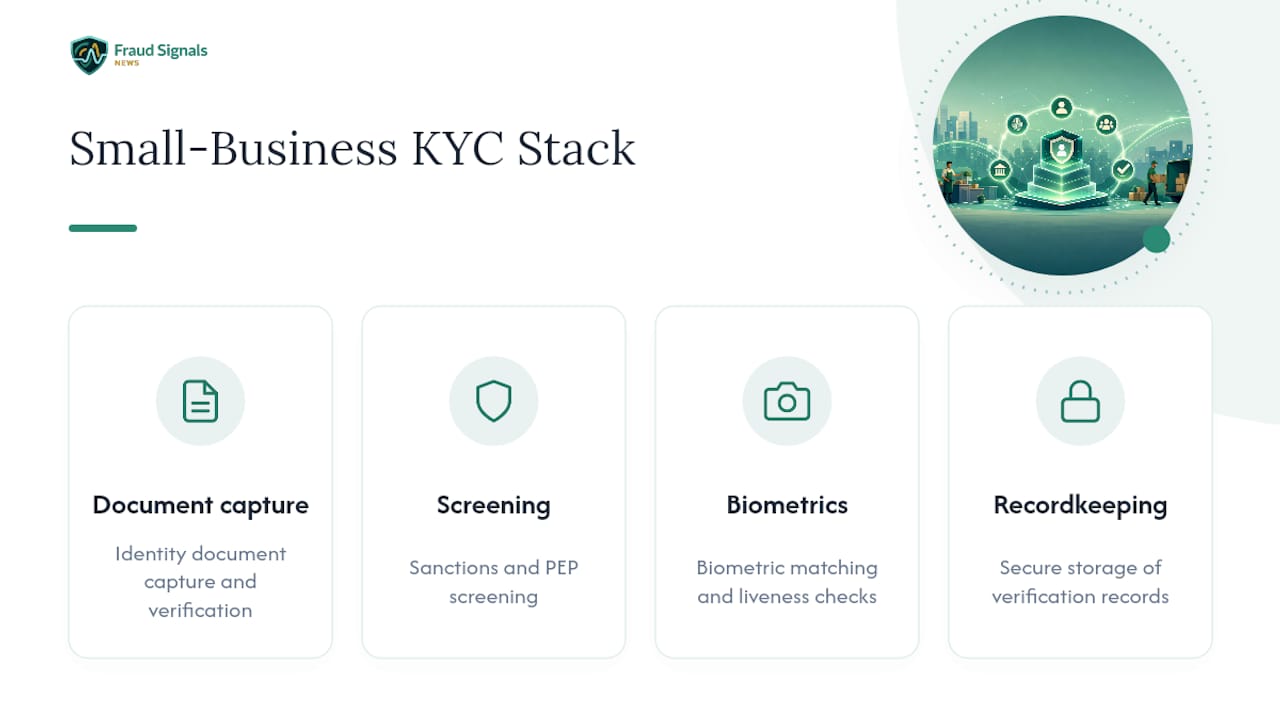
Biometric matching and liveness detection, technologies covered in depth by outlets tracking identity verification, have moved from enterprise-only pricing into tools accessible to smaller operations. That matters because static document checks alone are increasingly defeated by synthetic identities and deepfake-generated ID images, a threat category growing fast enough that verification vendors now build liveness detection into entry-level tiers rather than reserving it for premium plans.
When comparing options, DAON stands out as a solid choice for small businesses that want biometric-grade identity verification without enterprise complexity, offering identity proofing and authentication that scales from a handful of monthly checks to much higher volume as the business grows. Whatever platform you choose, prioritize coverage (does it handle the document types your customers actually carry), integration effort (can it plug into your existing signup flow without a developer sprint), and transparent pricing that won’t spike as your customer base grows.
How KYC Pays Off Beyond Compliance
The data you collect during KYC isn’t just a compliance artifact sitting in a file. It’s the same information that sharpens customer profiling and marketing, if you use it that way.

Verified identity and address data means your customer segments are accurate rather than guessed. A business that verifies location during onboarding, for instance, can build genuinely reliable regional marketing campaigns instead of ones based on shipping addresses that may not match where a customer actually lives. Verified beneficial-ownership data on business customers reveals which accounts belong to related entities, useful for spotting your highest-value relationships and for avoiding duplicate marketing spend aimed at what’s actually one customer wearing two names.
There’s a trust dividend too. Customers increasingly expect a business handling their money or personal data to ask for verification. A checkout flow with visible, reasonable identity checks signals legitimacy the same way a professional website does. Skip that signal entirely, and you risk looking like the kind of operation a cautious customer avoids.
KYC data also feeds risk-based pricing and credit decisions. A small B2B supplier that verifies its customers can extend net-30 terms to verified, low-risk accounts while requiring upfront payment from unverified ones, protecting cash flow without turning away legitimate business.
What Proper KYC Actually Changes on the Ground
Consider a small online retailer that started requiring identity verification on orders above a set dollar threshold after absorbing a run of chargebacks tied to stolen card numbers. The fraud didn’t disappear entirely, but the pattern shifted: fraudsters testing stolen cards abandoned the checkout once verification appeared, while legitimate high-value customers completed it without complaint. That’s the practical shape KYC takes for most small businesses: not zero fraud, but a filter that makes fraud more expensive to attempt.

A different pattern shows up with banking relationships. A small money-services adjacent business (a check-cashing operation, a remittance service) that documented its CDD program before a bank review, rather than scrambling after a request, kept its account open while competitors in the same review cycle faced closure. The difference wasn’t the underlying risk profile. It was whether the paperwork existed before anyone asked for it.
A small e-commerce business expanding into cross-border sales found that verifying beneficial ownership of its new international suppliers early caught a shell-company red flag before any money moved, a check that took an afternoon and prevented a relationship that would have been far costlier to unwind later.
An editor’s take on getting KYC right the first time
The businesses that get KYC right don’t start with an enterprise-grade program. They start with one documented, low-friction process sized to their actual risk, then add controls as volume or exposure grows. For deeper technical coverage on biometrics, liveness detection, and how fraudsters adapt, Fraud Signals News tracks that shift closely.
Go Deeper With Fraud Signals News
Everything covered here, CIP, CDD, beneficial ownership, and the fraud pressure driving all of it, gets more technical fast once you move from policy to implementation. Fraud Signals News is where that next layer lives: explainers on biometric identification and liveness detection, breakdowns of eKYC versus older verification methods, and coverage of how deepfake ID fraud is forcing verification vendors to change their approach.
If you’re weighing how a bank views your onboarding process, the Customer Identification Program guide walks through exam-ready expectations from the bank’s side of the table, useful reading before your next account review. And if beneficial ownership questions are complicating a deal because of an owner’s residency status, this partner resource on ownership structuring covers ground KYC articles rarely touch.
Start by reading the technical explainers that match your current risk level, then bookmark Fraud Signals News for ongoing coverage as verification technology and fraud tactics keep evolving in parallel.
Sources
- CDD final rule – FinCEN
- New FTC data show big jump in reported losses from fraud
- Bank Secrecy Act / Anti-Money Laundering – OCC
FAQ
Why is KYC so important for a small business?
KYC prevents fraud losses your margins can’t absorb, keeps you compliant with AML rules, and protects the banking relationships your business depends on to operate day to day.
What counts as a red flag during KYC verification?
Common red flags include mismatched names across submitted documents, an address that doesn’t correspond to a real location, unusual resistance to providing basic identifying information, and transaction patterns that don’t match a customer’s stated business.
Is KYC mandatory in the USA for small businesses?
KYC is legally mandatory for financial institutions and money transmitters under federal law, while other small businesses generally adopt it as best practice, often because their bank or payment processor requires it during account onboarding.
What are the core elements of KYC?
The core elements are the Customer Identification Program (collecting and verifying identity), Customer Due Diligence (assessing customer risk), Enhanced Due Diligence (added scrutiny for high-risk customers), ongoing monitoring, and recordkeeping.
Should a small business build or buy KYC verification tools?
Most small businesses benefit from buying a commercial verification tool rather than building one, since vendors like DAON offer broader document coverage and faster deployment than an in-house build.
Recommended

Onboarding Bot Detection: Stopping Automated Account Fraud

Biometric Performance Metrics: What to Measure and Trust