

A risk-tiered credit application fraud detection workflow — ingest signals at form submit, enrich in real time, score against a calibrated model, route by risk band, investigate flagged cases, and feed outcomes back into the model — stops the majority of application fraud while protecting approval rates. Immediate actions for any team standing up or hardening this process: enable device fingerprinting and identity enrichment at the moment of form submission; configure medium-risk applications for step-up verification (biometric or document-based, with DAON as a strong option for biometric step-up); route high-risk scores to a manual investigation queue with defined SLAs. Feedzai represents the category of enterprise-grade, real-time risk platforms that can anchor the scoring and orchestration layer. The five KPIs every fraud program must instrument from day one are:
- Fraud rate: confirmed fraud as a percentage of approved applications
- False-positive rate: legitimate applications incorrectly flagged or declined
- Approval rate: the conversion health metric that keeps fraud controls honest
- Time-to-detect: elapsed time from application submission to fraud disposition
- Analyst throughput: cases resolved per analyst per day, which governs queue SLA compliance
Consumer-facing remediation must align with FCRA adverse-action requirements and FTC guidance on credit freezes and fraud alerts, both of which directly affect how your team handles declined applications and victim outreach. Fraud Signals News covers the biometric, liveness, and deepfake developments that reshape this workflow continuously — the threat surface does not hold still.
Table of Contents
- What is credit application fraud, and what are the main types?
- Why is application fraud rising, and what does it cost U.S. lenders?
- How does the end-to-end detection and response workflow operate?
- What does the stage-by-stage playbook look like in practice?
- Which signals and detection techniques actually work?
- How should analysts investigate and document fraud cases?
- How do you validate, test, and tune detection models?
- What does the implementation and integration checklist cover?
- What emerging threats should fraud teams prepare for now?
- What U.S. regulations govern credit application fraud detection?
- Key Takeaways
- The feedback loop is where most programs actually fail
- Useful sources
- FAQ
What is credit application fraud, and what are the main types?
Credit application fraud is the deliberate submission of false, stolen, or fabricated identity information to obtain credit under false pretenses. The term covers several distinct attack patterns, and the detection technique that works against one type often fails against another. Getting the taxonomy right is the prerequisite for building controls that actually match the threat.
Synthetic identity fraud is the dominant and fastest-growing variant in the U.S. market. A fraudster constructs a fictitious identity by combining a real Social Security number (often belonging to a child, elderly person, or someone with a thin credit file) with fabricated name, address, and date-of-birth data. The synthetic persona is then “credit-built” over months or years — small secured cards, authorized-user tradelines — until the credit file looks plausible enough to support a large credit line. The attack culminates in a bust-out: the fraudster maxes all available credit and disappears. Detection signals include thin-file anomalies such as a credit file age that does not match the applicant’s claimed age, and sudden appearance of high-limit tradelines with no prior history.
First-party fraud (sometimes called “friendly fraud”) involves a real person applying with their own identity but with the intent to default. The applicant is genuine; the intent is not. Signals here are behavioral and financial: income misrepresentation, device reuse across multiple applications, and affordability ratios that fail stress tests. Unlike synthetic fraud, link analysis adds limited value — the identity is real and consistent.
Third-party identity theft is the classic scenario: a fraudster uses a real victim’s stolen credentials to apply for credit. The victim’s credit file is established and clean, which is exactly why this attack is dangerous. Velocity signals, device mismatch, and behavioral biometrics (typing cadence, mouse movement patterns inconsistent with the account holder’s historical behavior) are the primary detection levers.
Mule-assisted and bust-out patterns often combine elements of the above. A network of synthetic or stolen identities applies across multiple lenders simultaneously, each building credit quietly before a coordinated bust-out. Network and link analysis — surfacing shared device hashes, phone numbers, email domains, or IP addresses across applications — is the only technique that reliably catches coordinated rings.
Why is application fraud rising, and what does it cost U.S. lenders?
Digital onboarding removed the physical friction that once slowed fraudsters down. When a branch visit and a face-to-face document check were required, application fraud was expensive to execute at scale. Today, the same attack can be automated across dozens of lenders in hours. That structural shift is the primary driver of rising application fraud volumes in the U.S.
Synthetic identity economics have also changed. Stolen SSNs are inexpensive on criminal marketplaces, and the tools to generate supporting documentation have become accessible. AI-driven document spoofing now produces ID images that defeat basic optical character recognition checks. Voice deepfakes and facial synthesis attacks are no longer theoretical — they are active threats against lenders using voice or selfie-based identity verification, a development Fraud Signals News tracks closely in its biometrics and liveness coverage.
The business impact compounds across multiple cost centers. Direct credit losses from bust-out fraud are the most visible line item, but the operational cost of investigations, increased loss provisioning, and the customer experience degradation caused by over-aggressive controls all erode margin. A false-positive rate that blocks legitimate applicants at scale is not a “safe” outcome — it is a revenue leak with a compliance dimension, because adverse actions trigger FCRA notification obligations regardless of whether the declination was correct.
For U.S. institutions, the regulatory exposure is real. The Red Flags Rule requires financial institutions and creditors to implement written identity theft prevention programs. FCRA mandates specific adverse-action notices when a consumer report contributes to a denial. The FTC’s consumer protection framework gives victims the right to place fraud alerts and credit freezes, both of which affect how lenders must handle subsequent applications from those consumers. Institutions that lack documented, auditable detection workflows face examination risk on top of direct fraud losses.
How does the end-to-end detection and response workflow operate?
The workflow has six stages, each with a distinct owner and a defined handoff. Treating them as a continuous loop rather than a linear sequence is what separates programs that degrade over time from those that improve.
Stage 1 — Intake and signal capture is owned by product and engineering. At the moment of form submission, the system captures device fingerprint, IP address, session behavioral data, email address, phone number, and any document images submitted. Nothing downstream works well if signal capture is incomplete at this stage.

Stage 2 — Enrichment runs in near-real time. The application data is passed to credit bureau APIs, email reputation services, IP geolocation and proxy detection, phone carrier lookup, and any AML watchlist checks required by policy. An operational fraud pipeline routes this through a feature store for low-latency lookups, with streaming enrichment feeding the model service within the synchronous scoring budget.
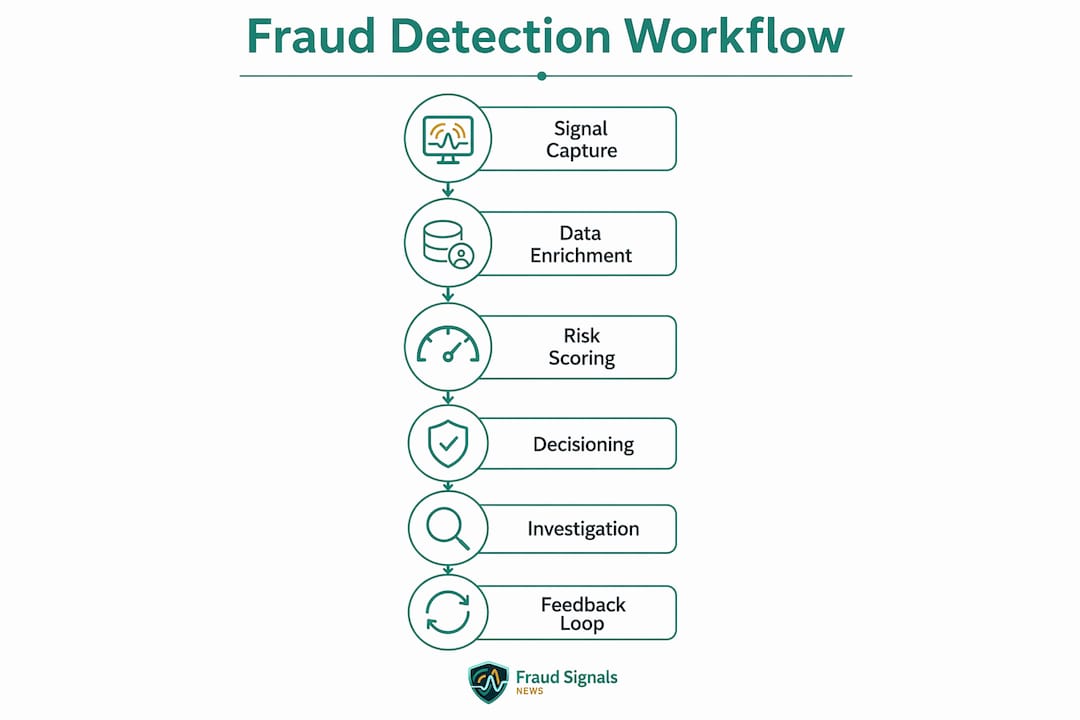
Stage 3 — Risk scoring is owned by the ML and risk team. The enriched feature vector is passed to the model service, which returns a continuous risk score. Rules-based checks run in parallel — velocity limits, known-bad device hashes, watchlist hits — and the highest-severity signal governs the initial routing decision.
Stage 4 — Orchestration and decisioning is where the score maps to an action. Workflow orchestration ties enrichment, scoring, and routing into a single auditable system; without it, models produce accurate scores that never translate into consistent operational decisions. Low-risk scores auto-approve. Medium-risk triggers step-up verification. High-risk routes to the manual investigation queue. Hard blocks apply to watchlist hits and known-bad signals regardless of model score.

Stage 5 — Investigation and remediation is owned by fraud operations, with legal and compliance involved for adverse-action documentation and victim support. Analysts work the queue, collect evidence, make disposition decisions, and document outcomes.
Stage 6 — Feedback and model retraining closes the loop. Analyst dispositions — fraud confirmed, false positive, legitimate — are programmatically linked back to the original application metadata. Without this linkage, supervised models degrade as fraud tactics evolve and the training data grows stale.
Real-time scoring (stages 1–4) must complete within the synchronous latency budget. Post-approval monitoring — watching for account build-out signals after onboarding — runs asynchronously and feeds back into the same orchestration layer.
What does the stage-by-stage playbook look like in practice?
Each stage has specific tasks, owners, and measurable outputs. The table below maps the operational checklist.
| Stage | Key Actions | Owner | KPI |
|---|---|---|---|
| Form submit / intake | Capture device fingerprint, session behavior, email, phone, IP, document images | Product / Engineering | Signal capture completeness rate |
| Enrichment | Credit bureau pull, email reputation, IP geolocation, phone carrier, AML watchlist | Risk / Data Engineering | Enrichment latency (target: <150 ms) |
| Initial scoring | Run ML model + rules; generate composite risk score | ML / Risk | Time-to-score; model AUC |
| Decision routing | Auto-approve (low), step-up (medium), manual queue (high), hard block (watchlist) | Orchestration layer | Approval rate; step-up conversion rate |
| Investigation | Triage queue, collect evidence, disposition (fraud / FP / legitimate) | Fraud Operations | Analyst throughput; queue depth; resolution SLA |
| Remediation | Adverse-action notice (FCRA), victim support, account closure, loss reporting | Legal / Compliance / Fraud Ops | FCRA notice compliance rate; time-to-remediate |
| Feedback | Link dispositions to application metadata; trigger retraining pipeline | ML / Risk | Labeled data volume; model drift metrics |
Threshold calibration guidance: low-risk bands (auto-approve) should be set conservatively at first and widened only after monitoring confirms the false-negative rate is acceptable. Medium-risk bands (step-up) are where risk-based routing pays the largest dividend — it preserves conversion for legitimate applicants who can pass a biometric or document check, rather than declining them outright. High-risk bands (manual review) should be sized to match analyst capacity; a queue that exceeds SLA becomes a backlog that degrades detection speed.
Government counter-fraud standards recommend proactive detection with SMART measurement — specific targets for fraud rate reduction, detection rate improvement, and false-positive reduction — rather than treating detection as a reactive function. Build those targets into the KPI dashboard from the start.
Recommended SLAs: manual review queue resolution within 24 hours for standard cases; 4 hours for high-value applications above a defined credit limit threshold. Adverse-action notices must comply with FCRA timing requirements.
Which signals and detection techniques actually work?
Detection quality depends on signal diversity. A single signal category — even a strong one — can be spoofed or gamed. The programs that hold up over time layer multiple independent signal categories so that defeating one does not defeat the stack.
Signal categories and their primary use cases:
- Device fingerprinting: browser/OS attributes, canvas fingerprint, installed fonts, screen resolution. Detects device reuse across multiple applications and known-bad device hashes. Limitation: sophisticated actors use device spoofing tools and residential proxies to rotate fingerprints.
- Behavioral biometrics: typing cadence, mouse movement, touch pressure, form-fill speed. Highly effective against credential-stuffed or bot-driven applications; harder to spoof than static identity data. Limitation: thin behavioral baseline for first-time applicants.
- Document verification: OCR, font consistency checks, metadata analysis of uploaded ID images. Catches low-quality document forgeries. Limitation: AI-generated documents now defeat basic OCR-based checks; liveness and injection attack detection are required.
- Identity graph and credit bureau linkage: cross-referencing SSN, name, address, and date-of-birth against bureau data and identity graph services. Primary tool for synthetic identity detection — surfaces thin-file anomalies and age mismatches. Limitation: synthetic personas with aged credit files can pass bureau checks.
- Velocity and transaction patterns: application frequency from the same device, IP, email domain, or phone number within a rolling window. Catches coordinated ring attacks. Limitation: rings that pace applications below velocity thresholds evade this control.
- Network and link analysis: graph-based detection of shared attributes across applications (same device hash across 10 different applicants, same phone number on multiple synthetic identities). The most effective technique against organized fraud rings. Limitation: computationally expensive; requires a graph data infrastructure investment.
Confidence tiers: tier-1 signals (watchlist hit, known-bad device hash, document injection attack detected) warrant an immediate hard block regardless of model score. Tier-2 signals (thin-file anomaly, velocity flag, IP proxy detection) are supporting evidence that raises the risk score but should not block alone. Combining two or more tier-2 signals typically justifies step-up verification.
The layered stack architecture runs rules first (fast, cheap, catches known-bad patterns), then enrichment, then ML scoring (catches novel patterns the rules miss), then orchestration routing. For medium-risk applications, DAON’s biometric step-up capability is a strong option — it adds a liveness-checked selfie or document scan without requiring a full manual review, preserving conversion while adding a meaningful identity assurance layer.
Pro Tip: Run your step-up authentication rate as a leading indicator. If it climbs sharply without a corresponding increase in confirmed fraud, your medium-risk threshold is too aggressive and you are degrading conversion unnecessarily.
For a deeper look at how biometric controls integrate into this stack, Fraud Signals News’s coverage of authentication design patterns is worth bookmarking.
How should analysts investigate and document fraud cases?
Consistent investigation discipline is what separates a fraud program that improves from one that generates data noise. Every case that enters the queue should follow the same triage flow, capture the same evidence fields, and produce a disposition that the model pipeline can consume.
Analyst triage flow:
- Initial screening: confirm the application triggered the correct routing rule or model score; check for obvious false-positive indicators (returning customer with established history, step-up passed cleanly).
- Evidence collection: pull device hash, IP geolocation, enrichment snapshots (bureau response, email reputation score, phone carrier), document verification result, and session behavioral summary.
- Identity cross-check: run the SSN, name, and address combination against the identity graph; look for shared attributes with other applications in the queue or recent history.
- Disposition decision: fraud confirmed, false positive, or legitimate with elevated monitoring. Document the reasoning, not just the outcome.
- Escalation: cases above a defined credit exposure threshold, cases involving potential organized rings (shared attributes across multiple applications), or cases with potential regulatory implications escalate to senior fraud ops and legal/compliance.
Required ticket fields: application ID, timestamp, risk score at routing, device hash, IP address, enrichment snapshot (bureau pull date and result, email reputation score), document verification result, identity graph flags, analyst ID, disposition, disposition rationale, escalation flag, and credit exposure amount.
The escalation matrix should define severity tiers by credit exposure and ring indicators, with SLA targets for each tier and named contacts in legal, compliance, and collections. Cross-team communication on ring cases is particularly critical — a coordinated bust-out ring hitting multiple product lines simultaneously requires a response that no single team can coordinate alone.
How do you validate, test, and tune detection models?
Model accuracy at deployment is not the same as model accuracy six months later. Fraud tactics evolve, applicant populations shift, and feature distributions drift. A model that is not actively monitored and periodically retrained will degrade — often silently, with the first visible symptom being a rising fraud rate or a spike in false positives.
Core metric definitions:
| Metric | Definition | Target Direction |
|---|---|---|
| Fraud rate | Confirmed fraud / total approved applications | Minimize |
| False-positive rate | Legitimate applications declined or stepped up incorrectly / total legitimate applications | Minimize |
| Precision | Confirmed fraud / total flagged as fraud | Maximize |
| Recall | Confirmed fraud caught / total actual fraud | Maximize |
| AUC | Area under the ROC curve; overall model discrimination | Maximize (a high operational target) |
| PSI | Population Stability Index; measures feature distribution drift | Alert threshold typically >0.2 |
| Time-to-detect | Elapsed time from application to fraud disposition | Minimize |
Testing protocol: new rules and models should run in shadow mode for several weeks before affecting live decisions. Shadow mode means the new logic scores every application and logs its output, but the production decision is still made by the current live model. This lets you validate performance on live traffic without risking a false-positive spike that damages conversion. After shadow mode, A/B validation routes a defined percentage of traffic to the new model while the remainder stays on the current version. Backtesting against historical confirmed fraud cases validates recall before any live exposure.
Rollout gating follows a canary pattern: 5% of traffic, then 20%, then full deploy, with automatic rollback triggers if fraud rate or false-positive rate exceeds a defined threshold at any gate.
Calibration routines: run a threshold sweep across the confusion matrix to identify the cutoff that minimizes the combined cost of false positives (lost conversion) and false negatives (fraud loss). That cost ratio is a business input, not a technical one — fraud teams and finance need to agree on it explicitly. Monitor PSI and per-feature drift on a weekly cadence, and set automated alerts for distribution shifts that exceed the PSI threshold. Retraining cadence depends on fraud velocity in your portfolio — monthly is a reasonable baseline; faster-moving attack patterns may require bi-weekly cycles.
Effective fraud programs treat detection as a continuous cadence and track false-positive rate alongside fraud rate. High false-positive rates erode customer trust; successful teams prioritize threshold tuning and model monitoring over simply tightening controls.
What does the implementation and integration checklist cover?
Standing up a production-grade fraud detection pipeline requires decisions across data, architecture, latency, and privacy before a single model is deployed. Skipping the architecture planning phase is how teams end up with accurate models that fail operationally.
- Connect data sources: application form fields, device signal SDK or JavaScript tag, session logs, credit bureau API (Equifax, Experian, or TransUnion), AML watchlist feeds, third-party enrichment providers (email reputation, IP intelligence, phone carrier lookup).
- Define latency targets: synchronous scoring — the path from form submit to routing decision — should complete within 50–150 ms depending on the number of enrichment calls in the critical path. Async pipelines for post-approval monitoring have no hard latency constraint but should complete within minutes to catch early account build-out signals.
- Implement the feature store pattern: pre-compute and cache features (velocity counters, device history, identity graph lookups) so the model service can retrieve them in single-digit milliseconds rather than recomputing at score time. This is the primary architectural lever for hitting synchronous latency targets.
- Build the streaming ingestion layer: route application events through a streaming platform (Apache Kafka or Amazon Kinesis are common choices) to decouple ingestion from scoring and enable replay for backtesting.
- Deploy the model service: containerized inference endpoint with sub-100 ms p99 latency; version-controlled model artifacts; shadow-mode capability built in from the start.
- Configure the decision engine: maps continuous risk scores to routing actions (approve / step-up / queue / block); supports rule overrides for watchlist hits; produces an auditable decision record for every application.
- Integrate case management: the decision engine’s output feeds directly into the investigation queue; analyst dispositions write back to the application metadata store to close the feedback loop.
- Privacy and data minimization: PII fields (SSN, full name, date of birth) must be encrypted at rest and in transit; retention schedules must comply with applicable state privacy laws (CCPA for California residents, for example) and internal data governance policies. Log enrichment outputs for auditability, but do not retain raw bureau response data beyond the minimum required period. Document the legal basis for each data element collected.
- Audit trail: every scoring event, routing decision, and analyst disposition must be logged with a timestamp, application ID, model version, and decision rationale. This is not optional — it is the evidence base for FCRA adverse-action documentation and regulatory examination.
For a detailed look at low-latency pipeline architecture, Fraud Signals News’s guide on real-time fraud detection implementation covers the feature store and model serving patterns in depth.
What emerging threats should fraud teams prepare for now?
The threat surface for credit application fraud is shifting faster than most detection programs can adapt. Three vectors deserve specific attention in 2026.
AI-synthesized documents have crossed the threshold where basic OCR and font-consistency checks are no longer sufficient. Generative models can produce ID images that pass visual inspection and defeat first-generation document verification tools. The mitigation is multi-layered: metadata analysis (EXIF data, compression artifacts inconsistent with a genuine camera capture), injection attack detection (detecting when a synthetic image is injected directly into the camera API rather than captured live), and liveness-checked selfie matching. Teams evaluating identity verification vendors should ask specifically about injection attack detection rates and how the vendor tests against adversarial synthetic documents.
Voice and facial deepfakes are active threats against lenders using voice authentication or selfie-based liveness checks. Passive liveness detection — which analyzes texture, depth, and micro-movement without requiring the user to perform an action — is more resistant to replay and deepfake attacks than active (challenge-response) liveness alone. DAON’s biometric platform includes liveness detection capabilities designed to address exactly this attack vector. When evaluating any biometric vendor, demand published false-acceptance rates for deepfake attacks, not just for standard spoofing.
Synthetic identity automation now operates at scale. Fraud rings use scripted pipelines to generate hundreds of synthetic personas, apply across multiple lenders, and manage the credit-building phase with minimal human involvement. The detection response is network-level: link analysis that surfaces shared infrastructure (device hashes, phone numbers, email domains, IP ranges) across applications that appear unrelated at the individual level.
Vendor evaluation questions for procurement teams:
- What is the model’s false-acceptance rate against injected synthetic images and deepfake video?
- Can the solution run in shadow mode before affecting live decisions?
- How does the vendor explain model decisions for adverse-action documentation purposes (explainability)?
- What is the published false-positive rate in production deployments comparable to your portfolio?
Human review remains essential for ring cases, novel attack patterns that fall outside model training data, and any case where the adverse-action documentation requires a judgment call that cannot be automated. The goal is not to eliminate human review but to ensure analysts spend their time on cases where their judgment adds value.
What U.S. regulations govern credit application fraud detection?
U.S. fraud teams operate under a layered regulatory framework that directly shapes how detection workflows must be designed, documented, and communicated to consumers.
FCRA (Fair Credit Reporting Act) governs the use of consumer reports in credit decisions. When a credit report contributes to an adverse action (denial, reduced credit limit, less favorable terms), the institution must provide a written adverse-action notice that identifies the consumer reporting agency used, states the applicant’s right to a free copy of the report, and explains the right to dispute inaccurate information. This is not discretionary — it applies to every adverse action where a consumer report was a factor, including fraud-driven declines.
Red Flags Rule (implemented under FACTA, enforced by the FTC and banking regulators) requires financial institutions and creditors to develop and implement written identity theft prevention programs. The program must include procedures to detect, prevent, and mitigate identity theft in connection with covered accounts. A documented, auditable fraud detection workflow is the operational foundation of Red Flags Rule compliance.
FTC consumer protection tools give fraud victims two primary remediation options that directly affect lender workflows. Credit freezes are free and prevent new credit checks from being processed — meaning a consumer who has placed a freeze at all three major bureaus cannot have a new credit application approved until the freeze is lifted. Fraud alerts instruct lenders to take extra steps to verify the applicant’s identity before granting credit. Initial fraud alerts last one year; extended fraud alerts (for confirmed identity theft victims) last seven years. Both tools affect the remediation workflow: when a victim requests a fraud alert or freeze, the fraud team’s process must accommodate that request and document it.
For consumers navigating the credit application process and its fraud risks, understanding credit health fundamentals is a useful starting point before engaging with lenders.
Compliance checklist for fraud and product teams:
- Adverse-action notice process documented and tested for every scenario where a consumer report contributes to a decline
- Red Flags Rule written program in place, reviewed annually, and approved by the board or a designated senior committee
- Credit freeze handling: process for detecting a frozen bureau file and communicating appropriately with the applicant
- Fraud alert handling: process for triggering enhanced identity verification when a fraud alert is present on the bureau file
- Audit trail: every scoring event and routing decision logged with model version and decision rationale for examination readiness
- Consumer dispute process: documented pathway for applicants to dispute adverse actions and request re-review
The FTC’s consumer protection framework also means that fraud victims who contact your institution have specific rights. Remediation workflows must include a clear escalation path to a team that can handle victim support, initiate account closure, and assist with bureau dispute filing.
Key Takeaways
A risk-tiered credit application fraud detection workflow — combining real-time enrichment, calibrated ML scoring, step-up authentication for medium-risk cases, and closed-loop feedback from analyst dispositions — is the operational foundation every U.S. fraud program needs in 2026.
| Point | Details |
|---|---|
| Risk-tiered routing over binary rules | Route medium-risk to step-up verification (e.g., DAON biometric) rather than blocking; preserves conversion while adding identity assurance. |
| Shadow mode before live deployment | Run new models and rules in shadow mode for several weeks to validate performance without risking false-positive spikes. |
| Closed-loop feedback is non-negotiable | Programmatically link analyst dispositions back to application metadata; without this, supervised models degrade as fraud tactics evolve. |
| FCRA and Red Flags Rule compliance | Document every adverse action with the required FCRA notice; maintain a written Red Flags Rule program reviewed annually. |
| Instrument five core KPIs from day one | Track fraud rate, false-positive rate, approval rate, time-to-detect, and analyst throughput to measure program health continuously. |
The feedback loop is where most programs actually fail
The operational playbook described here is well-understood in principle. The gap between programs that work and programs that merely exist is almost always in the feedback loop and the governance cadence around it.
Most fraud teams invest heavily in the front-end controls — device fingerprinting, document verification, ML scoring — and then treat the investigation queue as a cost center rather than a data asset. Analyst dispositions get logged in a case management system that has no programmatic connection to the model training pipeline. The model scores keep running, the fraud tactics keep evolving, and the model’s recall quietly degrades until the fraud rate spikes enough to trigger a reactive response.
The more defensible position is to treat every analyst disposition as a labeled training example and build the infrastructure to consume it automatically. That requires a deliberate architectural decision — the case management system must write outcomes back to the application metadata store in a format the ML pipeline can ingest — and it requires governance: someone owns the retraining cadence, someone reviews the PSI dashboard weekly, and someone has the authority to roll back a model that is drifting.
The same logic applies to the regulatory side. FCRA adverse-action compliance and Red Flags Rule documentation are not one-time implementation tasks. They require ongoing process discipline: every new product, every new data source, every model change needs to be evaluated for its compliance implications before it goes live. Teams that treat compliance as a deployment gate rather than a continuous practice tend to discover gaps at the worst possible moment — during an examination or after a consumer complaint.
Fraud Signals News tracks the biometric, liveness, and deepfake developments that feed directly into this workflow. The threat surface for synthetic identity and AI-generated document fraud is moving faster than annual model retraining cycles can accommodate. The programs that stay ahead are the ones that treat detection as a continuous operational discipline, not a project with a go-live date.
Useful sources
For teams implementing or auditing a credit application fraud detection program, these are the primary references worth reading in full.
- FTC: Credit Freezes and Fraud Alerts — the authoritative consumer-facing explanation of both tools; essential reading for remediation workflow design. Fraud ops teams should read this before designing the victim support process.
- OCC: Credit Card and Debit Card Fraud — the OCC’s guidance on fraud recognition and reporting; useful for compliance teams mapping detection obligations to regulatory expectations.
- PSFA Standards for Fraud Detection Practitioners — government counter-fraud standards covering proactive detection, measurement frameworks, and SMART action planning; relevant for fraud ops and program governance leads building a formal detection exercise plan.
- Payments & Risk: Fraud Detection — practical signal taxonomy and layered stack guidance; ML engineers and fraud analysts building detection logic should start here.
- Fraud Signals News: Fintech Fraud Coverage — ongoing coverage of identity verification, biometrics, liveness detection, and deepfake ID threats; bookmark for continuous threat monitoring.
- Fraud Signals News: Machine Learning Fraud Detection Guide — in-depth ML guidance for fraud model testing, monitoring, and retraining cadence; recommended for ML engineers and risk model owners.
- Fraud Signals News: Account Opening Fraud Detection — practical guide on account-opening fraud patterns; useful companion reading for the stage-by-stage playbook.
By role: fraud ops analysts should prioritize the FTC guide, the PSFA standards, and the Payments & Risk signal taxonomy. ML engineers should focus on the machine learning guide and the implementation architecture references. Compliance officers should start with the OCC guidance and the FCRA/Red Flags Rule primary sources. All roles benefit from ongoing monitoring of Fraud Signals News for biometric and deepfake developments that affect detection stack design.
FAQ
What is credit application fraud?
Credit application fraud is the submission of false, stolen, or fabricated identity information to obtain credit under false pretenses. The main types are synthetic identity fraud, first-party fraud, third-party identity theft, and mule-assisted bust-out schemes.
What does a fraud investigation workflow look like?
A fraud investigation workflow moves from triage (initial screening and evidence collection) through identity cross-check and disposition (fraud confirmed, false positive, or legitimate), then escalation for high-value or ring cases, and finally programmatic feedback of outcomes back into the detection model.
How do you detect credit application fraud in practice?
Detection combines device fingerprinting, behavioral biometrics, document verification, credit bureau enrichment, velocity checks, and network link analysis into a layered stack; a risk score routes each application to auto-approve, step-up verification, manual review, or hard block.
What is the credit card fraud detection process?
The process runs from signal capture at form submit through real-time enrichment and ML scoring, to a decision engine that maps the score to an action, followed by investigation of flagged cases and feedback of confirmed outcomes back to the model for retraining.
How do credit freezes and fraud alerts affect lender workflows?
A credit freeze blocks new bureau checks entirely, preventing approval until the consumer lifts it; a fraud alert requires the lender to take extra identity verification steps before granting credit. Both are free consumer tools under FTC guidance and must be accommodated in the remediation workflow.
Recommended

Measure Fraud Prevention ROI: Steps for Fraud Leaders

Ways to Reduce Identity Fraud Exposure in 2026