Background screening is a mature industry. Employers run criminal record checks, verify employment history, confirm credentials, and in regulated sectors, validate identity documents against authoritative sources before a single badge is issued. The logic is sound: know who you’re hiring before you hire them.
But there’s a structural flaw in that logic that the fraud and the identity risk community has been slow to confront—the verification event happens once, but the risk doesn’t.
The Snapshot Problem
Pre-hire screening produces a point-in-time snapshot of an individual’s identity and risk profile. It answers the question: Who was this person on the day we checked? What it cannot answer—and was never designed to answer—is: Who is this person operating as six months into their tenure? Two years in? After a role change that expanded their access?
Identity risk is not static. The insider threat literature is explicit on this point. Employees experiencing financial distress, coercion, or ideological radicalization don’t arrive that way on day one. The conditions that elevate risk develop over time, inside the organization, after every pre-hire control has already been satisfied.
There’s also a more operationally common problem that gets less attention: credential sharing, role substitution, and access delegation. An employee who passes a thorough pre-hire check may routinely hand their credentials to a colleague, work from a shared account, or allow a contractor to operate under their identity for convenience. None of this registers as anomalous in a system that stopped verifying identity at the point of hire.
What the industry needs, and what a growing number of high-assurance environments are beginning to implement, is continuous employment verification: an ongoing assurance process that confirms the person accessing systems and performing sensitive actions today is the same verified individual who cleared screening at hire.
Where the Gap Hurts Most
The exposure is sharpest in three contexts:
1. High-privilege roles
System administrators, finance personnel with payment authority, and employees with access to regulated data represent disproportionate risk if their identity integrity degrades. Pre-hire screening on these roles is standard. Continuous assurance is not, yet the blast radius of a compromised high-privilege account is orders of magnitude larger than that of a standard user.
2. Remote and hybrid workforces
The physical office created ambient identity verification. A manager could observe who was sitting at a workstation. Colleagues noticed when someone unfamiliar was operating in a sensitive area.
Remote work eliminated most of those informal controls without replacing them. The person authenticating from a home network with a valid credential is assumed to be the authorized employee. That assumption is increasingly difficult to justify without technical support.
3. Regulated industries
Financial services, healthcare, and government contractors operate under compliance frameworks that mandate knowing who has access to sensitive systems. Those frameworks were largely written before remote work became the default and before the concept of continuous identity assurance was technically feasible at scale.
The spirit of the regulations already requires what continuous employment verification would deliver. Implementation has simply lagged.
What Continuous Assurance Actually Looks Like
The implementation conversation is maturing. Biometric authentication is emerging as the practical mechanism for continuous workforce identity assurance, precisely because biometrics bind authentication events to a verified individual rather than to a credential that individual may or may not be holding.
Vendors operating at the intersection of identity verification and workforce authentication are beginning to close the pre-to-post-hire gap explicitly. Daon, whose platform spans document verification, biometric matching, and liveness detection, has extended its capabilities into continuous authentication use cases, enabling organizations to verify not just that a valid credential was presented, but that the person presenting it matches the verified identity on file. For regulated industries where the cost of identity compromise is existential, that distinction matters enormously.
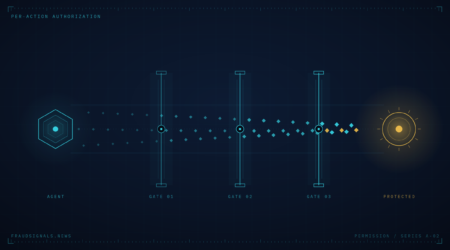
The operational model doesn’t require constant interruption. Continuous assurance can be implemented as step-up authentication triggered by risk signals: access to sensitive systems, transactions above defined thresholds, or behavioral anomalies detected by the identity platform. The employee experience is minimally disruptive; the assurance gain is substantial.
Finishing the Job
The pre-hire verification industry built something valuable. Credential fraud at the point of hire is meaningfully harder than it was a decade ago. Document verification is more sophisticated, identity databases are more interconnected, and screening providers have invested heavily in detection capability.
But treating that investment as sufficient—as the finished product of an identity risk program—is an error with measurable consequences. The organizations experiencing insider fraud, account takeover by credential sharing, and compliance failures tied to unauthorized access are, in most cases, organizations that screened carefully at hire and then stopped asking the question.
Continuous employment verification is not a replacement for pre-hire screening. It’s the second half of a job that was always supposed to have two halves.