

Knowledge-based authentication (KBA) verifies identity by asking someone to recall a shared secret, a childhood pet’s name, a former street address, an account PIN. It works, in the narrow sense that it can confirm a person knows a piece of information. But under the National Institute of Standards and Technology’s framework, knowledge-based verification tops out at FAIR assurance. It should never operate as a standalone control for anything that matters.
Security teams still lean on KBA for a reason: it’s cheap, it’s fast to deploy, and call centers have run on it for two decades. That doesn’t make it defensible in 2026, when data brokers, breached credential dumps, and social media scraping have made most “secret” answers a matter of public record.
KBA remains tolerable in a few narrow situations, generally as a temporary fallback or a low-risk step-up alongside other signals, never as the sole gate to sensitive data or high-value transactions. The rest of this briefing covers:
- How static and dynamic KBA differ mechanically and where each breaks down
- The specific attack patterns and failure metrics that should worry a risk team
- Where KBA still has a legitimate, bounded role
- A prioritized migration path toward phishing-resistant methods like FIDO2 and biometric proofing
Key Takeaways
Knowledge-based authentication caps out at FAIR assurance under NIST guidance and fails often enough in practice that it should never operate as a standalone control for sensitive accounts or transactions.
| Point | Details |
|---|---|
| KBA has a hard assurance ceiling | NIST caps knowledge-based verification at FAIR strength; STRONG and SUPERIOR require biometric or physical comparison. |
| Static KBA leaks through public data | Security-question answers are frequently discoverable via social profiles and breach dumps, undermining the shared secret. |
| Users forget answers routinely | About 20% of users forget security-question answers within six months, driving support and recovery costs. |
| KBA belongs in layered flows only | Reserve KBA for low-risk step-up or temporary fallback, paired with device signals or behavioral checks, never alone. |
| Migration should be risk-prioritized | Move highest-risk flows, like wire transfers and account recovery, to FIDO2 or biometric proofing first. |
Table of Contents
- What Is Knowledge-Based Authentication, and How Do Static and Dynamic Versions Differ?
- Why Does KBA Fail So Often in Practice?
- Where Does KBA Still Have a Legitimate Role?
- What Should Replace KBA, and How Should Teams Migrate?
- What Do NIST and Financial Regulators Actually Require?
- How Should Teams Handle Data, Privacy, and UX When KBA Is Still in Use?
- What Fraud Signals News Is Seeing Across the Fraud-Tech Beat
- Where Has KBA Worked, and Where Has It Failed in Practice?
- How Does KBA Affect User Experience and Customer Satisfaction?
- What Makes a Well-Designed KBA Question, if You Still Need One?
- Where Is KBA Headed as a Technology?
- An Editorial Take on Retiring KBA the Right Way
- Sources
- FAQ
What Is Knowledge-Based Authentication, and How Do Static and Dynamic Versions Differ?
Static KBA relies on questions a user pre-selects and answers during account setup: mother’s maiden name, first car, favorite teacher. The organization stores the answer, hashed or in plain text depending on how careless the implementation is, and compares it against the reply given at recovery time. The entropy problem is structural. Most people pick from a small pool of plausible answers, and TechTarget’s overview of knowledge-based authentication notes that static questions and their answers are frequently discoverable through public records or social profiles.
Dynamic KBA works differently. Instead of stored answers, it generates out-of-wallet questions in real time from credit bureau files, aggregated public records, or purchase history, asking something like “Which of these addresses have you lived at?” Wikipedia’s summary of static versus dynamic KBA frames dynamic KBA as harder to pre-stage because the questions aren’t fixed, though it depends entirely on third-party data quality.
The operational contrast matters for anyone budgeting a program:
- Static KBA costs less to build and maintain but degrades over time as answers leak.
- Dynamic KBA costs more, requires data-vendor contracts, and produces higher false-reject rates when a person’s credit file is thin or outdated.
- Both variants share the same ceiling: neither confirms government-issued identity or physical presence, only recall.
Why Does KBA Fail So Often in Practice?
Static KBA fails for a simple reason: the “secret” usually isn’t secret. Jumio’s analysis of KBA alternatives found a meaningful share of common security-question answers are publicly discoverable through social networking profiles alone, before a fraudster even touches a data broker. Add breached password dumps that frequently include security-question pairs, and static KBA becomes a guessing game with generous odds for the attacker.
Dynamic KBA has its own exposure. It depends on aggregated financial and public-record data, and fraud rings have learned to script attacks against these same databases, effectively answering “out-of-wallet” questions using the same breached data that makes the questions possible in the first place. When the data source itself has been compromised at scale, dynamic KBA inherits the weakness rather than solving it.
Statistic to know: A study on password-reset security questions found that roughly 20% of users forget their own security-question answers within six months. That single figure explains a large share of password-reset call volume and average handle time in most contact centers running legacy KBA flows.
Security teams evaluating whether to keep KBA in place should track:
- False accept rate (FAR) and false reject rate (FRR) on recovery attempts
- Recovery friction, measured as time-to-resolution and repeat-attempt volume
- Account-takeover incidents traced back to KBA-gated recovery flows
- Support ticket volume tied specifically to forgotten or failed security answers
Where Does KBA Still Have a Legitimate Role?
KBA hasn’t disappeared, and it doesn’t need to disappear everywhere at once. It persists in contact-center IVR systems and legacy agent workflows because it’s inexpensive and works over a phone line with no app or hardware token required, a point industry research on KBA in contact centers backs up directly.
Acceptable uses tend to share a common shape:
- Low-risk step-up for actions like checking a balance, not moving money
- Temporary fallback during an authentication-system outage
- One factor among several in a layered verification flow, never the only gate
KBA is inadequate wherever identity assurance needs to reach IAL2 or IAL3 under NIST’s model, opening a new financial account, verifying a patient’s identity for medical records, or approving a large wire transfer. The decision to remove KBA from a flow should be triggered by risk tier, not habit: if the transaction touches regulated data, moves money above a defined threshold, or has shown elevated fraud signals in the past quarter, KBA needs to come out of that path.
What Should Replace KBA, and How Should Teams Migrate?
The replacement landscape breaks into three assurance tiers, and the right choice depends on what’s actually at stake in the transaction.
- Phishing-resistant MFA (FIDO2/WebAuthn) removes the shared-secret problem entirely by binding authentication to a physical device or platform key, eliminating the guessable-answer attack surface.
- Document verification plus biometric matching (eKYC) pairs a government ID scan with a live facial match, which is the closest analog to in-person identity proofing and satisfies NIST’s STRONG and SUPERIOR verification tiers.
- Device reputation plus one-time passcodes work as a transitional control, better than static KBA alone, but still vulnerable to SIM swapping and shouldn’t be treated as a permanent end state.
- Risk-adaptive authentication adjusts friction dynamically, stepping up to biometric verification only when a session shows anomalous behavior, keeping low-risk sessions fast.
Each option trades differently on cost, user friction, and vendor dependency. FIDO2 requires device or platform support and a rollout period for user education. Biometric eKYC needs reliable liveness detection to resist injection and deepfake attacks, which raises vendor selection to a serious technical decision rather than a checkbox. Fintech teams building onboarding flows should also review how identity verification works inside consumer-facing money transfer apps, since the friction trade-offs there mirror what banks face at account opening.
Pro Tip: Run the migration in cohorts, not a single cutover. Start with your highest-risk transaction types, wire transfers, credential resets on privileged accounts, and move the lowest-risk flows last. A phased sunset timeline for legacy KBA gives support teams time to adjust scripts and gives fraud analytics time to catch regressions before they scale.
What Do NIST and Financial Regulators Actually Require?
NIST’s SP 800-63A framework doesn’t ban knowledge-based verification, it just caps what it can prove. Static and dynamic KBA both land at FAIR strength; reaching STRONG or SUPERIOR verification requires physical or biometric comparison, and remote proofing specifically requires liveness detection to confirm a real person is present, not a photo or a synthetic replay.
“Knowledge-based verification methods provide only fair confidence in the claimed identity and should not be the sole basis for identity proofing at higher assurance levels.” This is the operating principle behind NIST’s verification guidance, and it’s the standard most audit frameworks now cite by reference.
Regulatory pressure compounds this. FFIEC guidance for financial institutions and FTC enforcement actions have both pushed banks toward layered authentication rather than single-factor KBA gates, and HIPAA-covered entities face similar scrutiny when patient identity verification relies solely on recall-based questions.
If KBA remains anywhere in your control set, document it properly for audit purposes:
- The specific risk tier and transaction types where KBA still applies
- Compensating controls layered alongside it (device signals, OTP, behavioral checks)
- A documented sunset date or review cycle tied to the migration plan
How Should Teams Handle Data, Privacy, and UX When KBA Is Still in Use?
Any KBA implementation still running needs operational discipline, not just a migration deadline sitting on a roadmap.
- Vet third-party data sources for dynamic KBA questions. Confirm SLA terms, refresh frequency, and error rates before trusting a vendor’s data to gate account recovery.
- Minimize personal information exposure in the questions themselves. Asking for a Social Security number fragment as a “security question” creates a second data-leak surface on top of the authentication risk.
- Disclose clearly what data is used to generate questions and give users a real opt-out or alternative verification path, particularly under state privacy laws that treat this data as sensitive.
- Monitor operational KPIs continuously: recovery call volume, average handle time, false accept and reject rates, and confirmed fraud incidents tied to KBA-gated flows.
- Layer in device reputation and behavioral telemetry so KBA is never the only signal driving a step-up decision, an approach compliance teams can build into an identity verification upgrade checklist.
What Fraud Signals News Is Seeing Across the Fraud-Tech Beat
Our coverage of banking and fintech fraud keeps surfacing the same pattern: deepfake ID attacks are getting cheaper to run, and data-broker availability keeps expanding the pool of answers attackers can find for static KBA questions. Automated social scraping now does in minutes what used to take manual research.
- Liveness detection and biometric matching raise assurance meaningfully because they require a live, present human, not just recalled data.
- Vendors like DAON have built dedicated biometric and liveness-detection platforms specifically to close the gap KBA leaves open.
- Teams piloting a replacement should treat biometric proofing as the target state, not an experiment, given where fraud tooling is headed.
Where Has KBA Worked, and Where Has It Failed in Practice?
The clearest KBA failures show up in account-recovery fraud at scale. Fraud rings that acquire breached credential dumps routinely find security-question answers bundled alongside passwords, since many services store both together. When a bank’s password-reset flow relies on static KBA alone, an attacker who already has the breached data set doesn’t need to guess anything, they already hold the answer key. This pattern shows up repeatedly in account opening fraud investigations, where synthetic identities pass initial KBA checks because the underlying data was assembled specifically to answer those questions correctly.
KBA’s better outcomes tend to show up in bounded, low-stakes contexts. Contact centers that use dynamic, out-of-wallet questions as one factor among several, alongside voice biometrics or device recognition, report fewer takeover incidents than those relying on static questions alone. The difference isn’t the KBA itself, it’s that it’s never carrying the full weight of the decision.
Financial institutions that layered KBA with device fingerprinting and behavioral analytics during the transition period saw fewer disruptions than those that removed KBA abruptly without a bridge control. The lesson from both the failures and the qualified successes is consistent: KBA performs acceptably only when it’s one input among several, and it performs badly the moment it’s asked to carry a decision on its own.
How Does KBA Affect User Experience and Customer Satisfaction?
KBA creates friction in a way that’s easy to underestimate until you look at support ticket data. Users who can’t recall an answer they set years earlier, an old address, a childhood best friend’s name, get locked out of accounts they legitimately own, and that lockout translates directly into support call volume and abandoned transactions.

Dynamic KBA tends to frustrate legitimate users more than static KBA does, ironically, because questions pulled from credit files or public records can reference details a person genuinely doesn’t remember precisely, a previous employer’s exact name, a loan amount from six years ago. The security benefit of unpredictability comes at the direct cost of legitimate-user pass rates.
Customer satisfaction data across the industry consistently shows account recovery as one of the most abandonment-prone flows in digital banking and fintech onboarding. Every additional KBA question adds a decision point where a frustrated user gives up and calls support instead, shifting cost from a self-service flow to a live agent interaction. Biometric alternatives, by contrast, tend to resolve in seconds once enrolled, with no memory burden on the user at all. That gap in effort is exactly why fintech and banking teams increasingly frame the KBA-to-biometric migration as a customer-experience project as much as a security one.
What Makes a Well-Designed KBA Question, if You Still Need One?
If KBA has to remain in a workflow temporarily, question design still matters enormously for both security and friction. A poorly designed question fails on both counts at once.
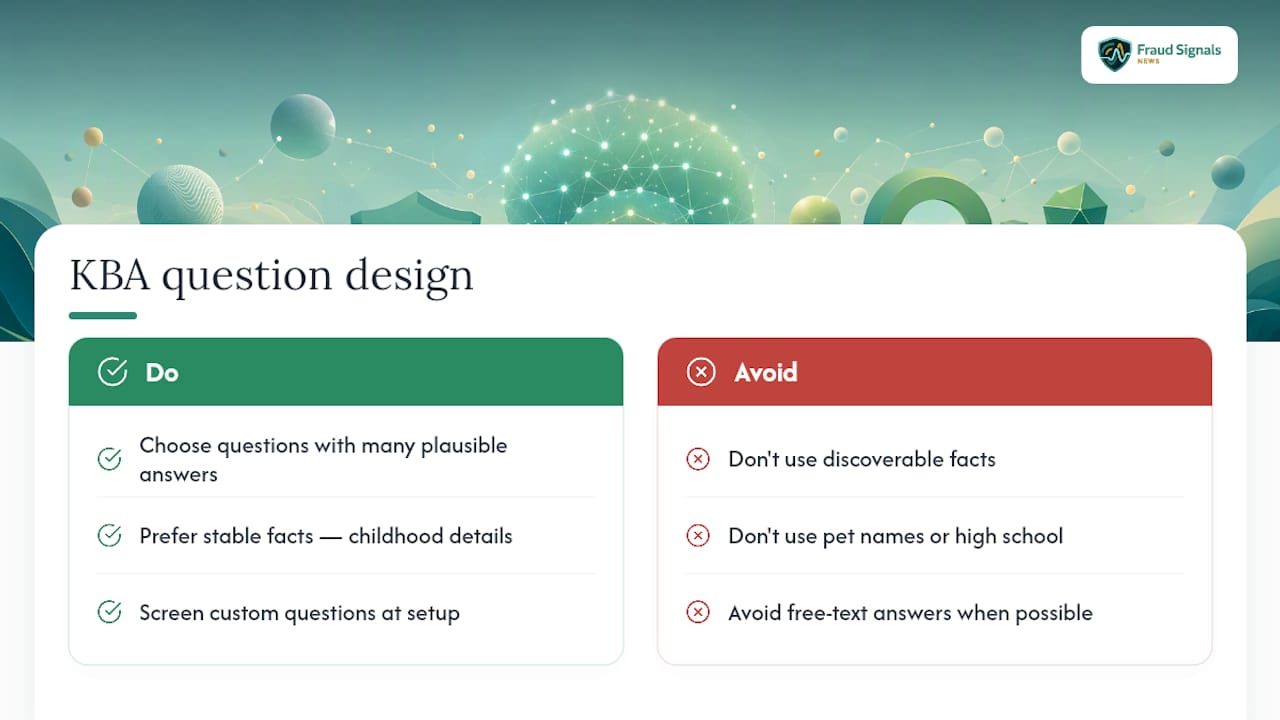
Good KBA questions share a few traits. They should have a large number of plausible answers, not a handful, since a question with only five common responses is barely better than no question at all. They should reference something stable over time rather than something that changes, a childhood detail works better than “your current favorite restaurant,” which shifts and gets forgotten. They should avoid anything discoverable through a public records search or a social media profile, which rules out most “pet’s name” and “high school” questions by default.
Question design should also account for how the question is delivered. Free-text answers introduce spelling and formatting mismatches that inflate false-reject rates, while multiple-choice formats reduce that friction but also reduce the effective entropy of the question. Some organizations now let users write their own custom question rather than choosing from a fixed list, which improves memorability but requires screening to block weak, guessable phrasing at setup time.
None of this changes the underlying assurance ceiling. Better question design lowers the false-reject rate and modestly raises resistance to casual guessing, but it does nothing to defend against an attacker who already holds breached data or has scraped a target’s social profile.
Where Is KBA Headed as a Technology?
KBA isn’t standing still, even as its ceiling stays fixed. AI-driven question generation is emerging as a way to build dynamic questions from a wider, more current data set in real time, reducing reliance on stale credit-file snapshots. The goal is fewer false rejects from outdated records and slightly better resistance to pre-staged attacks, since a question generated moments before use is harder to have prepared an answer for in advance.
Some vendors are experimenting with adaptive question difficulty, adjusting the specificity of a question based on a session’s existing risk score rather than asking the same fixed set every time. That’s a meaningful improvement over static one-size-fits-all flows, but it’s still recall-based authentication at its core, and it still can’t independently satisfy NIST’s STRONG or SUPERIOR verification requirements.
The more consequential trend isn’t happening inside KBA at all, it’s happening around it. Liveness detection, passive behavioral biometrics, and FIDO2 passkeys are absorbing the use cases KBA used to own, and the direction of investment across the identity-verification industry points toward recall-based questions becoming a legacy fallback rather than a growth category. Security teams planning multi-year roadmaps should treat any KBA improvement as a bridge, not a destination.
An Editorial Take on Retiring KBA the Right Way
The conventional advice on KBA has always been binary: keep it or kill it. That framing misses what the actual risk data shows. KBA’s failure isn’t that it’s worthless, it’s that organizations ask it to do a job it was never built for, standing alone as the final gate on high-value decisions.
What’s underrated in most migration plans is sequencing. Security teams tend to either rip out KBA everywhere at once, breaking legacy workflows and flooding support lines, or leave it everywhere indefinitely because a full replacement feels expensive. Neither is right. The actual priority is risk-tiering: identify the handful of transaction types where a KBA failure causes real financial or regulatory damage, and move those first. Everything else can wait for the next budget cycle.
The bigger shift worth watching isn’t a better version of KBA. AI-generated questions and adaptive difficulty are incremental patches on a control that has a fixed ceiling. The real move is toward biometric proofing and phishing-resistant MFA becoming the default, not the upgrade path. Teams that treat that as inevitable now will spend less fighting fraud later than teams still optimizing security questions in 2027.
— Carlos Ochoa
Sources
- Study: password-resetting security questions are easily guessed (ZDNet)
- NIST SP 800-63 implementation resources: verification (NIST)
- What is knowledge-based authentication? (TechTarget)
FAQ
What Is DocuSign’s Knowledge-Based Authentication?
DocuSign’s KBA feature verifies a signer’s identity by generating dynamic, out-of-wallet questions from public and private data sources before allowing access to a document, functioning as one layer in its identity-verification options rather than a standalone guarantee of identity.
What Are the Three Main Types of Authentication?
The three main factors are something you know (a password or security question), something you have (a token or device), and something you are (a biometric trait like a fingerprint or face). KBA falls into the first category.
What Is Considered a Knowledge Factor in Authentication?
A knowledge factor is any credential based on information only the legitimate user should know, passwords, PINs, and security-question answers all qualify, which is why NIST caps this factor’s assurance at FAIR strength.
Can You Give an Example of Certificate-Based Authentication?
A common example is a smart card or client certificate issued to an employee that cryptographically proves identity to a corporate network, a possession-based factor that doesn’t rely on recalled information the way KBA does.
Recommended

Onboarding Bot Detection: Stopping Automated Account Fraud

Biometric Performance Metrics: What to Measure and Trust