

Prioritize five things: identity lifecycle management anchored by a Master User Record, phishing-resistant MFA for every privileged account, a documented and rehearsed privileged access management program with break-glass procedures, continuous identity monitoring, and access reviews that generate real audit evidence rather than a signed checklist. Each maps to specific expectations under DORA Articles 9, 10, and 17, and each aligns with the access-control principles in NIST SP 800-207 and CISA’s identity and access management guidance.
- ILM sprint: Build a Master User Record this quarter, not next year.
- MFA rollout: Move privileged users to FIDO2 passwordless authentication first.
- PAM and break-glass: Separate admin accounts, record sessions, rehearse emergency access.
- Continuous monitoring: Instrument anomaly detection before an examiner asks for it.
- Access reviews: Produce timestamped, signed evidence, not a policy PDF.
Pro Tip: If you can only fix one thing before your next supervisory conversation, fix privileged account separation. It is the single control examiners check first, and the one most institutions still get wrong.
Key Takeaways
DORA compliance for identity depends on continuous, evidence-generating controls, not policy documents, with privileged access management as the single highest-priority fix.
| Point | Details |
|---|---|
| Start with the MUR | Build a Master User Record before layering on other identity controls. |
| Separate privileged accounts | Dedicated admin accounts and workstations close the most common audit gap. |
| Rehearse break-glass procedures | Untested emergency access SOPs fail when institutions need them most. |
| Track time-to-deprovision | Same-day deprovisioning after HR triggers is the target, not an annual goal. |
| Document, don’t just police | Examiners want signed, timestamped evidence, not policy text. |
Table of Contents
- What Does DORA Actually Require for Identity Controls?
- Which Identity Controls Should You Prioritize First?
- How Do You Map Identity Controls to DORA Evidence Requirements?
- What Does a 90-Day Identity Control Sprint Look Like?
- How Do You Measure Whether Identity Controls Are Working?
- What Are the Most Common DORA Identity Control Mistakes?
- What Should You Look for When Selecting Identity Tooling?
- Why an Identity-First Approach Beats Point Fixes
- Where to Go Deeper on DORA Identity Controls
- Sources
- FAQ
What Does DORA Actually Require for Identity Controls?
DORA does not hand institutions a neat identity checklist. It distributes the obligation across several articles, and compliance teams who miss that structure end up building controls that satisfy no one.
Article 9 sets the baseline for access control and requires policies covering authentication, authorization, and monitoring of who touches ICT systems. Article 10 pushes further into detection, meaning identity anomalies need to surface, not just get logged. Article 17 folds identity failures into incident response, so a credential compromise has to trigger the same playbook as a system outage. The regulatory technical standards layered on top specify strong authentication methods and set review cadences, particularly for privileged access.
The recurring theme across supervisory guidance is a shift away from paper compliance. Examiners increasingly expect operational evidence: logs, review outputs, remediation tickets, not a policy document nobody has touched since it was approved.
- Article 9: documented, implemented, tested access policies.
- Article 10: detection capability tied to identity anomalies.
- Article 17: incident response ownership for identity-related events.
- RTS: authentication strength requirements and access review frequency.
Third-party ICT providers extend these obligations further. If a vendor manages identity infrastructure, your institution still owns the resilience and access-governance outcome, which means contracts need audit rights and evidence obligations built in from day one.
Which Identity Controls Should You Prioritize First?
Not every control carries equal weight. The ones below are ranked by how directly they reduce fraud exposure and how consistently examiners ask for evidence of them.
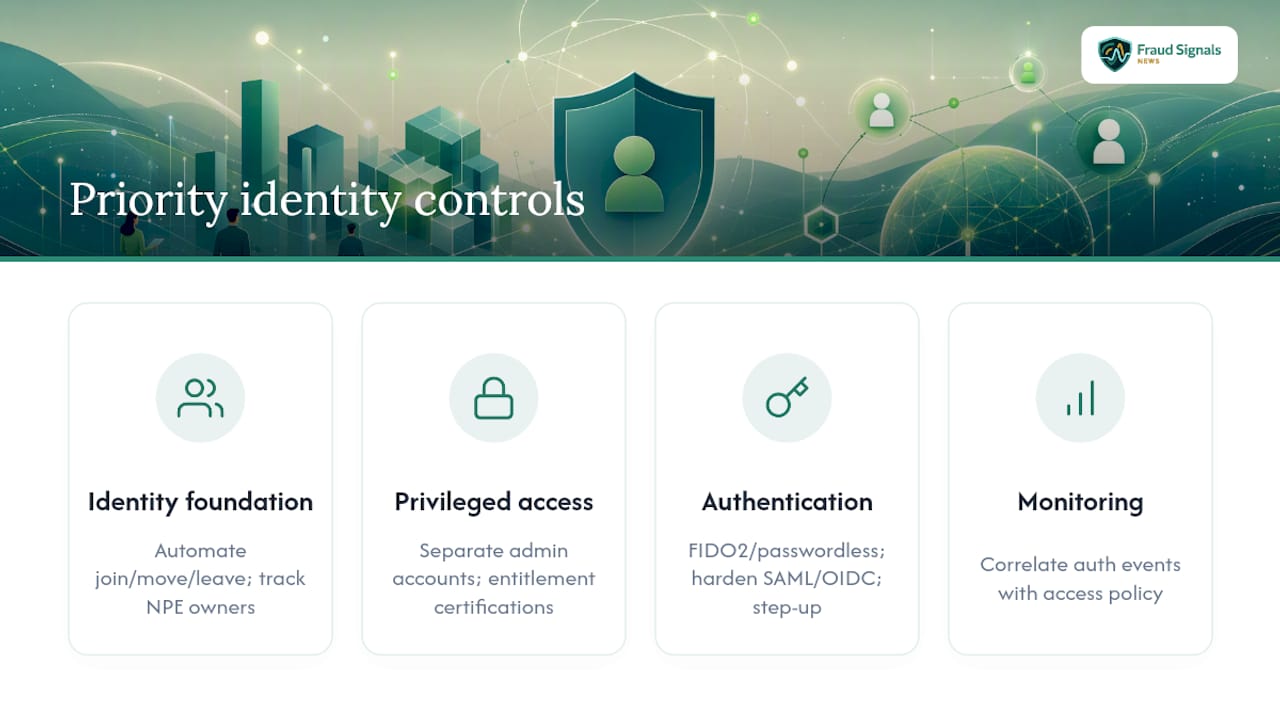
Identity lifecycle management (ILM) and the Master User Record. Automate join, move, and leave workflows so every access grant traces back to an authoritative HR feed. The ILM playbook frames this as the foundation for attribute-driven, Zero Trust access decisions, and orphaned accounts from broken ILM are one of the most common findings in identity audits.
Identity governance and administration (IGA). Document provisioning logic, enforce segregation of duties, and run entitlement certifications on a real schedule, not an annual scramble.
Phishing-resistant authentication. FIDO2 and passwordless credentials for privileged and critical-system access close the gap that SMS codes and push-fatigue attacks exploit. Layer step-up authentication onto high-risk actions like wire transfers over a set threshold.
Privileged Access Management (PAM). Separate admin accounts from daily-use accounts, record sessions, and use JIT/JEA to limit standing privilege. Break-glass accounts need their own SOP and a tested rehearsal schedule.
Federation and SSO hardening. Harden SAML and OIDC configurations, use attribute-based assertions, and eliminate local accounts wherever federation can replace them.
Continuous monitoring and logging. Correlate authentication events with access policy to catch impossible-travel logins and credential-stuffing patterns before they become fraud losses.
Non-person entity (NPE) management. Service accounts, bots, and APIs need the same lifecycle discipline as human identities, including expiration and ownership records.
Pro Tip: Treat every service account like an employee with a manager: assign an owner, set a review date, and revoke it the moment its purpose ends. Unowned NPE credentials are a favorite entry point for account-takeover fraud.
How Do You Map Identity Controls to DORA Evidence Requirements?
Auditors do not want narrative. They want a control, tied to a regulatory hook, tied to a document they can pull on demand. Build that mapping once and reuse it across every examination cycle.
| Control Area | Evidence to Produce |
|---|---|
| ILM/MUR | Provisioning logs, HR feed integration records, orphaned-account remediation tickets |
| Phishing-resistant MFA | Rollout plans, enrollment rates by role, exception approvals |
| PAM | Privileged-account inventory, session recordings, JIT/JEA grant logs |
| Access reviews | Signed certification records with timestamps and reviewer names |
| Break-glass procedures | Emergency access SOP, rehearsal logs, post-use review notes |
| Incident response | Playbooks with named roles, escalation timelines, closure reports |
Retention matters as much as creation. Keep sign-off names, timestamps, and linked remediation tickets so an examiner can trace a finding from detection to closure without a follow-up meeting. When you present evidence, lead with the control, then the artifact, then the date. Examiners move faster through material organized that way, and it signals a program that runs continuously rather than one assembled the week before the visit.
What Does a 90-Day Identity Control Sprint Look Like?
A phased sprint turns prioritization into something a team can actually execute without waiting on a multi-year platform overhaul.
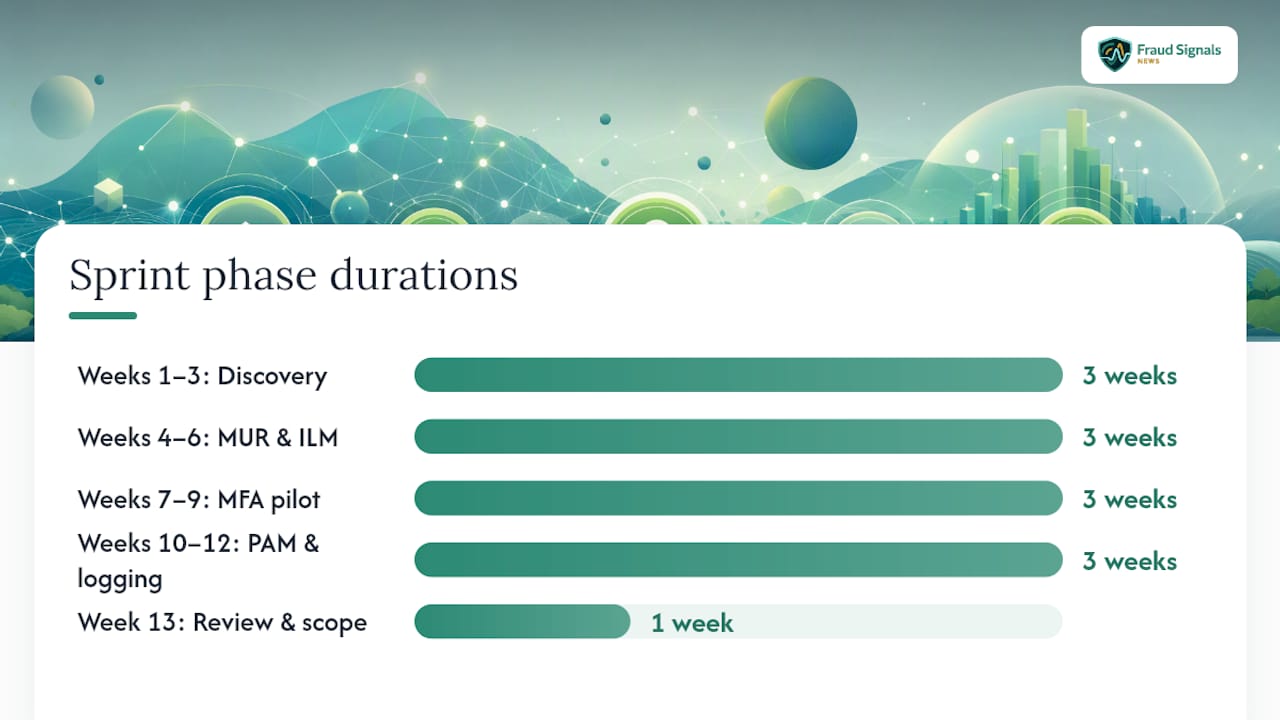
- Weeks 1 to 3: Discover every account, system, and directory. Identify your authoritative HR feed and flag directories that need consolidation.
- Weeks 4 to 6: Build an MUR prototype and map current provisioning workflows against it. Start drafting the ILM policy in parallel.
- Weeks 7 to 9: Pilot phishing-resistant MFA for privileged users. Stand up an emergency access vault and draft the break-glass SOP.
- Weeks 10 to 12: Implement PAM for a pilot scope, including session recording. Wire up monitoring and logging pipelines for identity events.
- Weeks 13: Review pilot results, document evidence gaps, and set the next quarter’s rollout scope.
Assign clear ownership before week one. The IAM owner drives technical build, the compliance lead owns evidence mapping, SRE or ops handles monitoring pipelines, HR confirms the authoritative feed, and application owners sign off on entitlement decisions for their systems. A simple RACI for the MUR build and the MFA pilot prevents the two most common sprint failures: nobody owning the HR integration, and application owners discovering mid-sprint that their system was never in scope.
Quick wins compound. Centralizing the directory and standing up the emergency access vault early removes blockers that would otherwise stall weeks 7 through 12.
How Do You Measure Whether Identity Controls Are Working?
A handful of metrics tell you more than a stack of policy documents ever will.
- MFA adoption rate for privileged accounts, tracked weekly during rollout.
- Time-to-deprovision for departing employees, measured from HR trigger to access removal.
- Count of orphaned accounts discovered per review cycle.
- Mean time to detect anomalous authentication events.
- Number of privileged-session recordings actually reviewed, not just captured.
Improvement looks like time-to-deprovision shrinking toward same-day, orphaned-account counts trending toward zero, and detection times measured in minutes rather than days. Set thresholds that trigger action automatically. If time-to-deprovision exceeds 48 hours or an orphaned account surfaces outside a review window, that should generate a ticket, not a footnote in next quarter’s report. Feed these metrics into automated alerts tied to your incident reporting workflow so a spike in anomalous authentications reaches the right team without a manual escalation step.
What Are the Most Common DORA Identity Control Mistakes?
Access reviews treated as paperwork rather than an operational control top the list. If a reviewer signs off without evidence of actually checking entitlements, that review protects no one, and examiners can usually tell.
Shared or local admin accounts persist longer than institutions admit. Every privileged user needs a dedicated account and, ideally, a dedicated workstation separate from daily email and browsing.
- Third-party access governance often stops at contract signing, with no ongoing tracking of vendor service-account use.
- Break-glass procedures exist on paper but have never been rehearsed under real conditions.
- Authentication failover goes untested until an outage forces the issue.
- Red flags examiners look for: missing review artifacts, inconsistent log formats across systems, and privileged accounts still active months after an employee’s exit.
Pro Tip: Run one break-glass rehearsal per quarter and document it like a fire drill. An emergency procedure nobody has practiced is a procedure that fails exactly when you need it most.
What Should You Look for When Selecting Identity Tooling?
Procurement decisions made without an evidence lens create rework later. Build the checklist around what an examiner will eventually ask to see, not just what a sales demo shows well.
Checklist items to confirm before signing:
- Native support for SAML/OIDC federation and FIDO2 passwordless authentication.
- PAM session recording with exportable, timestamped logs.
- IGA automation for provisioning and certification, not manual spreadsheet reviews.
- API-friendly integration with your MUR and HR feed.
- Offline or resilient authentication options for outage scenarios.
- Ask how the vendor exports audit trails, and confirm the format matches what your examiners expect.
- Confirm the SLA for authentication availability, including failover behavior.
- Verify JIT/JEA and break-glass workflow support out of the box.
- Get third-party access governance features in writing, including how vendor service accounts are tracked.
- Include resilience clauses and auditor data-access rights directly in the contract, along with vendor testing obligations under Article 23’s third-party risk provisions.
DAON is worth evaluating for institutions weighing biometric-backed identity verification alongside their core IAM stack, particularly where liveness detection needs to plug into an existing authentication pipeline.
Why an Identity-First Approach Beats Point Fixes
Institutions that patch identity gaps one incident at a time end up rebuilding the same controls repeatedly, at higher cost, with weaker evidence each time. Continuous, evidence-generating controls beat reactive fixes because examiners reward operational proof, not intent. Biometric verification, eKYC, and liveness detection strengthen identity signals further, but only once the foundational lifecycle and privileged-access controls are already producing reliable evidence.
Where to Go Deeper on DORA Identity Controls
- ILM playbook: use it for drafting your lifecycle and MUR policy.
- CISA IAM best practices: reference for technical hardening.
- RSA’s CISO playbook for DORA: guide for testing methodology.
- Microsoft Entra identity guidance: useful for procurement requirements.
This article is general information, not a substitute for advice from a qualified lawyer. Consult a qualified legal professional about your own circumstances before acting on anything here.
Sources
- Idmanagement
- Identity and Access Management: Recommended Best Practices for Administrators (CISA)
- DORA Identity Controls Requirements: What the Regulation Actually Demands | IdentityFirst Insights
- Identity management best practices (Microsoft Learn)
- A practical CISO playbook for DORA: Identity, continuity and controls (RSA)
FAQ
What Is the Master User Record Under DORA?
The Master User Record is the authoritative identity source that drives access decisions across systems, built through ILM automation tied to your HR feed.
Does DORA Require Phishing-Resistant MFA?
DORA’s regulatory technical standards call for strong authentication, and phishing-resistant options like FIDO2 are the recommended approach for privileged and critical-system access.
How Often Should Privileged Access Reviews Happen?
Privileged access reviews should happen more frequently than the general annual cycle, with many institutions moving to quarterly certifications for high-risk accounts.
What Evidence Do Auditors Expect for Identity Controls?
Auditors expect signed, timestamped access review records, provisioning logs, privileged-account inventories, and rehearsed break-glass procedure documentation, not policy statements alone.
How Do Non-Person Entities Fit Into DORA Identity Governance?
Service accounts, bots, and APIs need the same lifecycle discipline as human identities, including named ownership, expiration dates, and inclusion in access reviews.
Recommended

Biometric Performance Metrics: What to Measure and Trust

ID Security Features: What Each One Does and How to Check It