

An identity verification mandate is a legal requirement compelling individuals and organizations to confirm their identity through documented, auditable processes before accessing regulated services or holding corporate roles. The term is the informal label professionals use; the recognized industry standard is mandatory identity verification, embedded in frameworks like FATF Recommendation 10 and the UK’s Companies House mandate. Both frameworks share the same core logic: static, self-reported identity data fails to prevent fraud, so regulators now require verified proof. For compliance and fraud prevention professionals in finance and technology, understanding what an identity verification mandate demands operationally is no longer optional. The consequences of getting it wrong range from prosecution to reputational collapse.
What is an identity verification mandate and what does it require?
An identity verification mandate is a binding legal obligation requiring individuals or entities to prove their identity through accepted documents and processes before a regulated activity can proceed. Two frameworks define the current global standard.
The UK’s Companies House mandate, effective from november 18, 2025, requires all new directors and persons with significant control (PSCs) to complete identity verification. 6–7 million individuals are expected to comply by mid-november 2026. That scale makes this one of the largest mandatory identity verification rollouts in UK corporate history.

FATF Recommendation 10 sets the global standard for financial institutions. It requires verified identification of customers and beneficial owners at onboarding and for transactions over EUR/USD 15,000. Non-compliance with FATF standards is a primary driver of anti-money laundering (AML) enforcement actions worldwide. That linkage between identity verification and AML is not incidental. It is the regulatory logic that makes these mandates legally enforceable.
What are the main regulatory requirements and legal consequences?
Regulatory requirements under identity verification mandates carry specific timelines, document standards, and enforcement mechanisms that compliance teams must map precisely.
Under the Companies House framework, identification documents must be original, valid, legible, and in good condition. The rollout phases in over 12 months, with early verification actively encouraged. PSCs face a 14-day window to submit verification after their confirmation statement or birth month. Missing that window is not a minor administrative lapse.
The consequences of non-compliance are direct and personal:
- Directors and companies both face criminal offences for failure to verify.
- Penalties include prosecution and court fines for individuals, not just the corporate entity.
- Corporate officers cannot delegate liability by claiming ignorance of the requirement.
- Ongoing non-compliance compounds exposure, since regulators track verification status actively.
For financial institutions operating under FATF Recommendation 10, the stakes are equally high. Regulators expect documented evidence of customer due diligence at every threshold transaction. Enforcement actions against banks for AML failures routinely cite inadequate identity verification as a root cause. The financial penalties in those cases run into hundreds of millions of dollars globally.
Pro Tip: Map your regulatory obligations by jurisdiction before building your verification workflow. FATF Recommendation 10 and the Companies House mandate share the same goal but differ in scope, timelines, and document standards. Treating them as interchangeable creates audit gaps.
How do mandates affect operational processes in finance and technology?
Identity verification mandates change how organizations design onboarding, manage ongoing relationships, and retain evidence. The operational impact is deeper than most compliance teams initially anticipate.
The Companies House framework introduces a role-specific verification model that catches many professionals off guard. Each person must obtain a separate verification code for each role they hold. Verifying once as a director of Company A does not satisfy the requirement for Company B. Individuals must manually link their verified identity to each role they occupy. For professionals holding multiple directorships, this creates a recurring administrative obligation, not a one-time task.
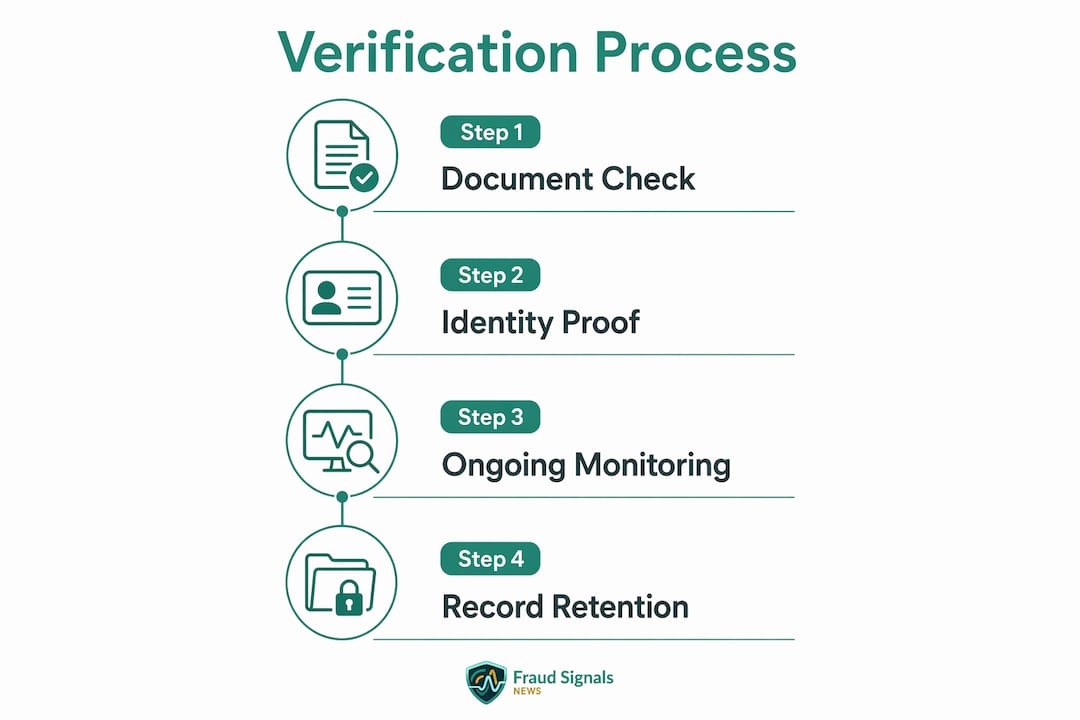
The typical identity verification process in a regulated financial context follows this sequence:
- Document collection. Accepted documents include passports, driving licenses, and proof of address. Documents must be original and valid, not scanned copies or expired credentials.
- Identity matching. The submitted document is matched against the individual’s claimed identity, often using biometric comparison or database cross-referencing.
- Sanctions and PEP screening. AML identity verification requires ongoing screening against sanctions lists, politically exposed persons (PEP) registries, and adverse media sources.
- Audit trail creation. Every decision, document reviewed, and outcome must be logged with sufficient detail to satisfy a regulatory audit.
- Lifecycle monitoring. Verification does not end at onboarding. Regulators expect continuous coverage throughout the customer relationship.
The audit trail requirement is where many programs fail. Compliance teams must retain detailed evidence of identity proofs and decision rationale for at least five years to satisfy regulators such as the FCA. Passing an onboarding screen without capturing the underlying evidence is insufficient. That gap is exactly what enforcement teams look for during examinations.
Pro Tip: Build your audit trail as a first-class output of your verification workflow, not an afterthought. Regulators do not accept reconstructed records. The evidence must be contemporaneous and complete.
What innovations are emerging to meet mandates efficiently?
The identity verification process is shifting from a static, document-centric check to a continuous, intelligence-driven model. That shift is driven by both regulatory pressure and the practical failure of legacy approaches to stop sophisticated fraud.
The most significant development is the move toward identity intelligence. Real-time risk scoring and adaptive friction now allow systems to analyze multiple signals simultaneously, including device telemetry, behavioral patterns, and network data, to evaluate trust continuously. This is not a marginal improvement. It changes the fundamental architecture of how verification works.
The table below compares the static verification model with the identity intelligence model:
| Dimension | Static verification | Identity intelligence |
|---|---|---|
| Timing | One-time at onboarding | Continuous throughout lifecycle |
| Signals analyzed | Documents only | Documents, behavior, device, network |
| Friction applied | Fixed for all users | Adaptive based on risk score |
| Fraud detection | Point-in-time | Ongoing, real-time |
| Audit output | Single record | Continuous event log |
A second major shift is the concept of identity as infrastructure. Treating identity as shared infrastructure means one verified identity can be reused across multiple workflows without repeating the full verification process. Organizations moving to this model report fewer redundant steps and lower operational burden. The practical benefit for compliance teams is that a single high-quality verification event generates reusable trust signals rather than siloed records.
Biometric binding and liveness detection are now standard components of enterprise-grade verification. These techniques confirm that the person presenting a document is physically present and alive, defeating the spoofing attacks that defeat static document checks. Fraud Signals News covers both technologies in depth, tracking how fraudsters adapt and how detection methods respond.
Pro Tip: When evaluating verification platforms, ask specifically how they handle continuous assurance after onboarding. A platform that only verifies at account opening leaves a gap that regulators and fraudsters both exploit.
Why does identity verification compliance matter for fraud prevention?
Identity verification is the foundation of every AML and fraud mitigation program. Without it, every downstream control operates on unverified assumptions about who the customer actually is.
The regulatory expectation has shifted decisively toward lifecycle verification. Regulators expect end-to-end coverage throughout the customer relationship, not just a clean onboarding record. That means sanctions screening, PEP monitoring, and adverse media checks must run continuously, not annually. Organizations that treat verification as a one-time gate are already non-compliant with current regulatory expectations.
The business case for strict compliance extends beyond avoiding fines:
- Enforcement costs. AML enforcement actions against financial institutions for identity verification failures carry fines that dwarf the cost of building a compliant program.
- Reputational damage. Public enforcement actions signal to customers, counterparties, and investors that the institution’s controls are inadequate.
- Fraud losses. Weak identity verification creates the low-assurance bypass that fraudsters exploit through account takeover, synthetic identity fraud, and money mule networks.
- Regulatory relationship. Institutions with documented, auditable verification programs receive more constructive engagement from regulators during examinations.
The importance of identity verification as a fraud prevention control is not theoretical. Every major financial crime case in the past decade traces back to a failure to verify who the customer actually was. The mandate frameworks exist because voluntary compliance produced inadequate results.
Key takeaways
Identity verification mandates are legally binding, role-specific, and lifecycle-oriented obligations that require documented evidence, continuous screening, and at least five years of audit-ready records to satisfy regulators like the FCA and Companies House.
| Point | Details |
|---|---|
| Mandate scope | Both Companies House and FATF Recommendation 10 require verified identity, not self-reported data. |
| Role-specific verification | Each corporate role requires a separate verification code; one-time verification does not cover multiple positions. |
| Audit trail retention | Regulators require at least five years of documented identity evidence and decision rationale. |
| Lifecycle monitoring | AML compliance demands continuous sanctions, PEP, and adverse media screening, not just onboarding checks. |
| Identity intelligence | Adaptive risk scoring and biometric binding replace static document checks in compliant enterprise programs. |
The compliance gap no one talks about
The most underappreciated failure mode in identity verification compliance is not the initial check. It is the period between onboarding and the next scheduled review. I have seen compliance programs that pass every audit at the point of customer acceptance and then go completely dark for 12 months. That gap is where the real risk accumulates.
The shift toward identity as infrastructure is the right direction, but most organizations are implementing it as a technology upgrade rather than a process redesign. The technology is necessary but not sufficient. What actually changes outcomes is treating every verification event as a data point in a continuous risk model, not a box to check and file away.
The five-year retention requirement from the FCA is also more operationally demanding than it appears on paper. Retaining the evidence is straightforward. Retaining it in a format that supports a live regulatory examination, with full decision rationale and chain of custody, is a different challenge entirely. Compliance teams that build their audit infrastructure after the fact consistently struggle to reconstruct the quality of evidence that regulators expect.
The organizations getting this right are the ones that treat mandatory identity verification as a permanent operational capability, not a project with a go-live date. The mandate does not end. Neither should the program.
— A. Johnson
Fraud Signals News and identity verification coverage
Professionals navigating identity verification mandates need more than a one-time briefing. Regulatory frameworks evolve, fraud techniques adapt, and the technology landscape shifts faster than most compliance programs can track.

Fraud Signals News covers the full spectrum of identity verification compliance and fraud prevention, from AML regulatory updates to the latest developments in biometric binding and liveness detection. The site’s fintech fraud coverage examines how financial institutions are adapting their verification programs to meet 2026 regulatory expectations. For professionals responsible for keeping verification programs current, Fraud Signals News provides the analysis and reporting that turns regulatory change into operational clarity. Visit fraudsignals.news to stay ahead of the mandates shaping the industry.
FAQ
What is an identity verification mandate?
An identity verification mandate is a legal requirement compelling individuals or organizations to confirm their identity through documented, auditable processes before accessing regulated services or holding corporate roles. Frameworks like FATF Recommendation 10 and the UK Companies House mandate are the primary examples currently in force.
Who must comply with the Companies House identity verification mandate?
All new directors and persons with significant control (PSCs) in the UK must complete identity verification, with 6–7 million individuals expected to comply by mid-november 2026. PSCs have a 14-day window to submit verification after their confirmation statement or birth month.
Does verifying once cover all corporate roles a person holds?
No. Each role requires a separate verification code under the Companies House framework. Verifying as a director of one company does not satisfy the requirement for any other directorship or PSC role the individual holds.
How long must identity verification records be retained?
Regulators such as the FCA require at least five years of retention for identity proofing evidence and decision rationale. Records must be contemporaneous and complete enough to support a live regulatory examination, not reconstructed after the fact.
What is the difference between static verification and identity intelligence?
Static verification confirms identity once using documents at onboarding. Identity intelligence uses real-time risk scoring, device telemetry, and behavioral signals to evaluate trust continuously throughout the customer lifecycle, providing ongoing fraud detection rather than a single point-in-time check.
Recommended

ID Security Features: What Each One Does and How to Check It

Face Liveness Detection: How It Works and Where It Fails