
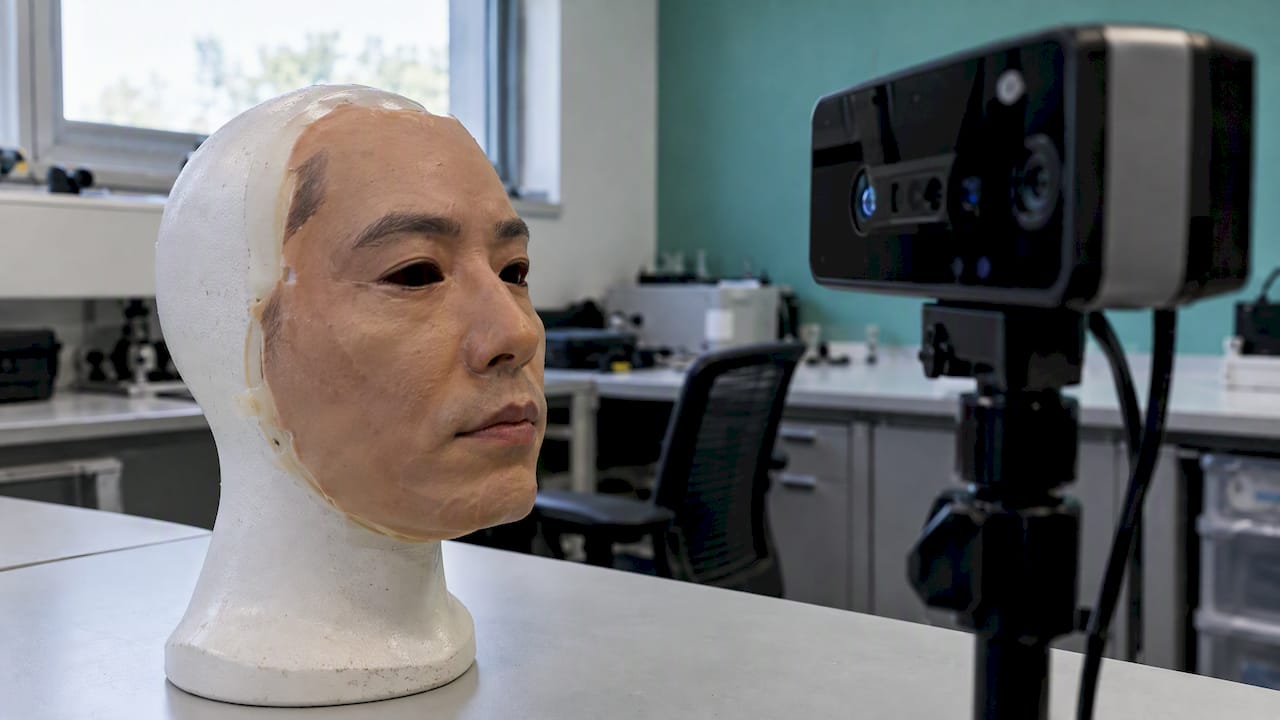
A 3D mask attack is a presentation attack in which an impostor wears a physical replica of an enrolled person’s face and holds it up to the camera, hoping the system reads shape, depth and texture as a genuine match. It is rarer and costlier than a printed photo or a replayed video, but it is the attack that exposes whether a liveness check is measuring anything real. This article explains how masks are built, what the published studies show about their success, and which detection layers have evidence behind them.
TL;DR
- A mask attack uses a three-dimensional artifact, so it defeats checks designed only for flat photos and screens, including simple blink and lip-movement prompts.
- Academic tests on custom silicone masks show real vulnerability in deep face recognition, but results depend heavily on the operating threshold and the lighting.
- Thermal and multispectral sensing, fused with ordinary color imagery, performed better in the research than visible light alone.
- Most public evidence comes from small, lab-built datasets, so treat published error rates as directional and test against your own capture conditions.
Table of Contents
- What a 3D mask attack actually is
- How masks differ from photo, video and replay attacks
- Rigid, silicone and cloth: why material changes the risk
- What the studies show about success rates
- 3DMAD: the dataset behind most of the research
- How detection works: the layers that have evidence
- Perspective: the mask is the test, not the threat
- A practical program for US fraud and risk teams
- Limits of the research that US organizations should weigh
- Where to go next
- FAQ
- Sources
What a 3D mask attack actually is
In the language of biometric standards, a mask attack is a presentation attack: an impostor presents a physical artifact modeled on a target’s face to the recognition sensor. The artifact tries to reproduce the target’s shape, depth, texture and sometimes movement closely enough to trigger an impersonation match. The goal is not to create a new identity. It is to borrow an enrolled one.
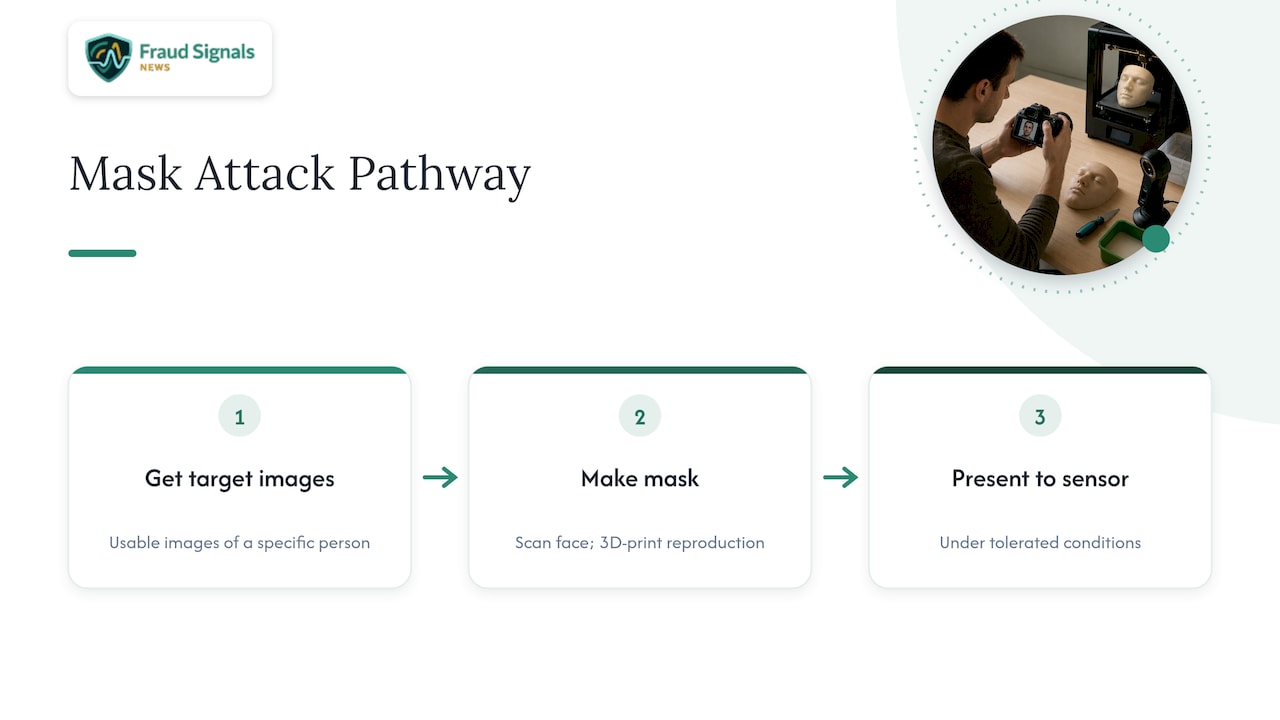
The production route matters for threat modeling. The same survey notes that masks can be made by scanning a face and 3D-printing a reproduction, and that the masks in the best-known research dataset were ordered from a service that accepted only frontal and profile photographs. That is a low bar for anyone whose face is publicly photographed, which describes most executives, influencers and anyone with a public social media profile.
That said, the attack is not frictionless. The attacker must obtain usable images of a specific person, pay for fabrication, and then present the mask to a sensor under conditions the system tolerates. This is why mask attacks cluster around high-value accounts and targeted fraud, not mass-scale account farming, where cheaper injection and replay techniques dominate.
How masks differ from photo, video and replay attacks
The attack types sit on a ladder of effort and realism. A systematic literature review separates print, digital-photo, replay, modified-print, deepfake, mask, sculpture, avatar, makeup and surgery attacks. For practical purposes, the first three matter most to a fraud team:
- Print attack: a face on flat paper.
- Digital-photo attack: a face shown on a screen.
- Replay attack: recorded video, which can include blinks, expressions and head movement.
- Mask attack: a three-dimensional material worn over the attacker’s face.
The difference is structural. The survey on mask detection describes 2D attacks as printed or digital photos and recorded videos, and says 3D masks have structure that makes them more challenging than flat artifacts. A depth sensor that rejects a phone screen has nothing obvious to object to when a rigid shape is placed in front of it.
There is also a behavioral gap. Replay attacks can show motion, but the motion is pre-recorded and cannot respond to a random prompt. A person wearing a mask can respond to any prompt, because a living human is behind it. Challenge-response checks that work well against video replay therefore lose much of their value against masks.
Rigid, silicone and cloth: why material changes the risk
Not all masks are equal. The mask-detection survey explains that rigid masks preserve three-dimensional shape, while flexible latex or silicone masks can provide closer skin-like color and texture and conform to different facial sizes, shapes and movements, which makes them harder for presentation-attack detection.
In practice, this gives fraud teams three tiers to think about:
- Rigid printed masks: capture geometry but look and reflect light like plastic. They are the easiest to catch with texture and reflectance analysis.
- Custom silicone masks: the most dangerous tier in the literature. Skin-like surface, flexibility and a fit to the wearer’s face.
- Low-cost textile or cloth masks: an accessible alternative to expensive silicone and latex. One public dataset advertises more than 11,000 attack videos built from cloth masks as a response to this trend; verify the current dataset details on the provider’s page before relying on them.
The lesson is that a control tuned against one material may fail against another. A test plan that includes only a single mask type produces a false sense of coverage.
What the studies show about success rates
The evidence that masks can work is real, but it is more nuanced than headlines suggest.
Deep face recognition is vulnerable to custom silicone
In a 2018 study of six custom silicone masks, all three evaluated convolutional neural network recognition systems had impersonation vulnerability at least ten times their false-match rate. The authors classified ratios above 10 as highly vulnerable. The same study found that attack success varied with lighting, a reminder that sensor conditions shape outcomes.
Threshold choice can change the picture
A 2019 study of two commercial systems used eight custom silicone masks. It found vulnerability mainly at higher false-accept thresholds; at a 0.01% false-accept operating point, the tested systems were not vulnerable in that experiment. The takeaway for a risk director is not that strict thresholds solve the problem. Strict thresholds raise false rejects, which cost conversion and customer trust. The takeaway is that the operating point is a security decision and should be set with mask attacks in the model.
Early 2D systems were fooled too
The foundational work by Erdogmus and Marcel examined subject-specific masks against several recognition systems, and its authors address both the spoofing potential and the detection problem. The same paper explains why classic liveness cues struggle: cut-out photographic masks can expose the wearer’s eyes and mouth so that apparent blinking or mouth movement is produced, while a real 3D mask can move with its wearer. Blink detection alone is therefore a weak answer.
3DMAD: the dataset behind most of the research
Most of what the public literature says about mask attacks traces back to the 3D Mask Attack Database, known as 3DMAD. According to a 2019 review, it is a publicly available set of 255 Kinect videos from 17 subjects. Each subject has ten genuine recordings from two sessions and five masked-attack recordings from a third session, with RGB, depth and eye-position annotations.
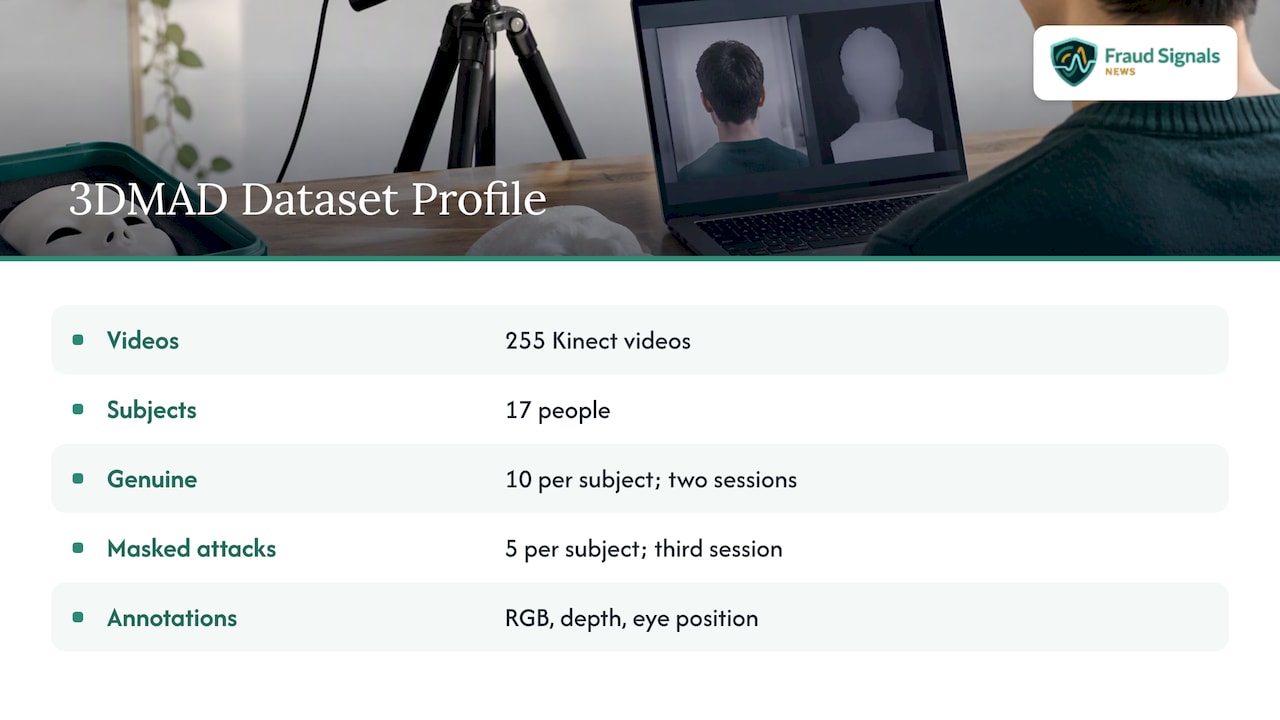
The technical details explain both its value and its limits. The recordings used a Microsoft Kinect at 640×480 resolution for both color and depth, 30 frames per second, for 76,500 frames in total. That is a decade-old sensor class, a tiny population and a single mask-making process.
Detection results on 3DMAD can look spectacular. Block-based local binary patterns with linear discriminant analysis produced a half total error rate of 0.95% on color images and 1.27% on depth images. But a later pulse-detection study reported that the unusually strong texture result may reflect visible 3D-printing defects and matched acquisition conditions rather than a general solution. Near-perfect numbers on a small dataset should raise questions, not relax them.
How detection works: the layers that have evidence
The survey of mask presentation attack detection reviews reflectance and multispectral, texture, shape, deep-feature and liveness approaches, including pulse-based methods and thermal imaging. Each answers a different question.
| Approach | What it measures | Where it is strong | Where it struggles |
|---|---|---|---|
| Texture analysis | Micro-patterns of the skin surface | Rigid and printed masks | Mask-specific tuning; weak transfer to new materials |
| Depth and shape | Facial geometry | Flat attacks | A mask supplies real geometry |
| Pulse (remote photoplethysmography) | Blood-flow signal in the video | Masks that cover the skin | Lighting, motion and compression noise |
| Thermal imaging | Heat emitted by living skin | Silicone and other insulating materials | Needs extra hardware |
| Multispectral fusion | Color, near-infrared and thermal together | Broadest coverage in the research | Hardware cost and integration |
The strongest evidence in the research favors sensing beyond visible light. A 2019 multispectral study of 21 custom masks found thermal imagery effective even with low-cost thermal devices, and fusing color, near-infrared and thermal channels significantly improved detection over any single-channel baseline. The earlier silicone-mask study reported that thermal images of live faces are distinct from mask attacks, and its preliminary method using a low-cost thermal camera reached an equal-error rate of 7.5%. That figure is promising for a first attempt and nowhere near sufficient for a bank’s production risk tolerance on its own.
The practical conclusion is that a single visible-light selfie flow has a ceiling. The conclusion of the multispectral authors is that fusion is more robust than one visible channel, with thermal data a practical extra signal. Whether your channel can collect that signal is a product question: a mobile app cannot add a thermal sensor, but a branch kiosk, an ATM or a border-style station can.
Perspective: the mask is the test, not the threat
Fraud teams tend to rank mask attacks low because they are expensive and rare, and for most onboarding flows that ranking is sensible. Our view is that this misses what masks are good for. A mask attack is the cleanest test of whether a liveness product measures a living person or merely checks that a face moved.
The research supports that reading. Blink and mouth-movement prompts can be satisfied by cut-out artifacts, and strong results on one small dataset can reflect the dataset’s quirks, not general robustness. When a vendor quotes a near-perfect error rate, the first question should be which attack types, which materials, which sensor and which threshold produced it.
We also see institutions treating capture as a solved problem while attackers move to injection and synthetic media, where the camera is bypassed entirely. A mask is the physical-world version of the same weakness: the system trusts what arrives at the sensor. Defenses built on layered signals, independent of any single cue, hold up against both.
Our editorial position is that liveness should be procured and audited like any other control: with named attack types, documented operating points and results on your own population. We cover those evaluation methods in depth because the buyers who ask hard questions end up with systems that deter fraudsters and keep honest customers moving.
Carlos Ochoa
A practical program for US fraud and risk teams
For a director of fraud risk, the research translates into a short list of decisions.
- Decide where masks belong in your threat model. High-value accounts, executive impersonation, remote account recovery and unattended kiosks justify more investment than low-limit signups.
- Set the operating point deliberately. The 2019 commercial-system study shows that a tighter false-accept threshold changed the vulnerability result. Record the chosen threshold, the false-reject cost and who approved the tradeoff.
- Demand attack-specific evidence. Ask vendors for results by attack category: print, replay, rigid mask, silicone mask. A single blended number hides the hard cases.
- Test under your own conditions. Lighting changed attack success in the silicone study, so test indoors, outdoors, low light and on your actual device mix.
- Add independent signals. Pair face liveness with device and session intelligence, document checks and step-up verification for risky events. Our guide to how face liveness detection works and where it fails covers the mechanics, and our analysis of liveness detection spoofing defenses maps them to standards.
- Protect the capture path. A flawless mask detector is irrelevant if a virtual camera feeds the pipeline. See our piece on fixing capture integrity to stop deepfake ID fraud.
If morphing is also on your radar, the face morphing detection checklist covers a neighboring document-level attack.
Limits of the research that US organizations should weigh
The public evidence is useful and thin at once. Four limits deserve a place in any vendor evaluation.
- Small populations. 3DMAD has 17 subjects. The custom silicone studies used between six and 21 masks. These sizes suit proof-of-concept work, not fraud-rate estimates for millions of customers.
- Dated and specialized sensors. The foundational dataset used a Kinect. Modern phone cameras, depth sensors and compression behave differently.
- Matched conditions. The pulse-detection authors cautioned that matched acquisition conditions could explain an unusually strong result. Real populations capture under uncontrolled light.
- Threshold dependence. Vulnerability at one operating point does not transfer to another, so a result must be read with its false-accept setting.
None of this means mask defenses are unproven. It means a test on your own users, devices and fraud patterns is worth more than any published number. To read independent benchmark data critically, our walkthrough of how to read NIST face test data is a good companion.
Where to go next
If you are building or auditing a biometric stack, start with the business case, then the controls. Our explainer on why biometrics reduce bank fraud lays out the operational argument, and the guide to eye tracking authentication examines a signal that can complement face checks.
Fraud Signals News publishes operations-focused coverage of biometric identification, liveness detection, deepfake ID technology and emerging fraud techniques, written for fraud, risk and compliance leaders in fintech, banking, healthcare and travel. Our liveness and spoofing guides give you the questions to put to any vendor before a contract is signed.

Start with our guide to liveness detection spoofing, or browse the latest analysis on the Fraud Signals News homepage.
FAQ
What is the difference between a 3D mask attack and a deepfake?
A mask attack is physical: a three-dimensional artifact is worn and shown to a camera. A deepfake is synthetic media, usually injected into the video stream or shown on a screen. The systematic literature review lists mask and deepfake attacks as separate categories, and they call for different defenses.
Can a blink or smile check stop a mask attack?
Not reliably. Research on 3D mask spoofing found that cut-out masks can expose the wearer’s eyes and mouth, producing apparent blinking or mouth movement, and that a real mask moves with its wearer. Treat these prompts as one weak signal, not a control.
What is 3DMAD?
It is a public research dataset of 255 Kinect videos from 17 subjects, with genuine recordings and masked-attack recordings, used widely to benchmark mask detection. Its recording specifications include 640×480 color and depth at 30 frames per second. It is valuable for comparing methods but small and dated for estimating real-world risk.
Does thermal imaging detect silicone masks?
Research says it is a promising signal. A multispectral study found thermal imagery effective even with low-cost thermal devices, and fusion with color and near-infrared improved results. It requires hardware that most mobile onboarding flows do not have.
Which channels should worry about mask attacks most?
Unattended or high-value channels: remote account recovery, high-limit accounts, executive impersonation and kiosks. For low-limit mobile signups, injection and replay attacks are generally the more common concern, so allocate testing effort by loss exposure.
Sources
- A survey on 3D mask presentation attack detection
- Presentation Attack Detection: A Systematic Literature Review
- Spoofing Deep Face Recognition with Custom Silicone Masks
- Custom silicone face masks: vulnerability of commercial face recognition systems
- Spoofing Face Recognition with 3D Masks
- Spoofing in 2D Face Recognition with 3D Masks and Anti-spoofing
- Generalized face anti-spoofing by detecting pulse
- Recent Progress on Face Anti-spoofing against 3D Mask Attack
- Countermeasure to Custom Silicone Mask Attacks
Recommended

Proof of Life Video: How Liveness Checks Work and Where They Fail
ISO 30107 Liveness: What Compliance Really Proves