

Doxim, a prominent customer communications management provider for credit unions and financial institutions, has agreed to a $5 million settlement to resolve a class action lawsuit stemming from a widespread data breach.
The lawsuit (Case No. 2:24-cv-11550, United States District Court for the Eastern District of Michigan) alleged that Doxim failed to adequately protect the highly sensitive personal and financial data of credit union members during a targeted cyberattack. While the company denies any wrongdoing, this multi-million-dollar resolution serves as the latest wake-up call for the financial services industry regarding vulnerabilities in third-party vendors and data security.
For impacted consumers, the clock is ticking. Class members have until a postmark deadline of October 13th to submit a claim for compensation, object, or opt out of the settlement entirely. Eligible individuals can find more information, review their rights, and file a claim directly at www.doximdatasecuritysettlement.com.
The Anatomy of the Breach: A Fraud Security Crisis
Here at FraudSignals.news, we continuously monitor the downstream effects of breaches like this one, and the reality is stark: fraud security is no longer just an IT compliance issue—it is a frontline imperative.
When bad actors bypass perimeter defenses, the fallout is devastating. In the Doxim incident, unauthorized actors allegedly accessed a treasure trove of personally identifiable information (PII). The leaked data is a fraudster’s dream, encompassing names, physical addresses, financial records, and Social Security numbers (SSNs).\
Once this caliber of information hits the dark web, it fuels a massive underground economy. Cybercriminals use stolen financial records and SSNs to orchestrate account takeovers, execute synthetic identity fraud, and open fraudulent credit lines. Financial institutions and their members are left to contend with the operational costs, reputational damage, and immense stress of restoring identities.
The Solutions-Focused Approach: Preventing the Next Breach
The Doxim settlement illustrates a painful truth: reactive security measures are no longer enough to protect client data. If financial institutions and their third-party vendors want to avoid costly class action litigation and safeguard consumers, they must adopt a proactive, zero-trust approach to data architecture.
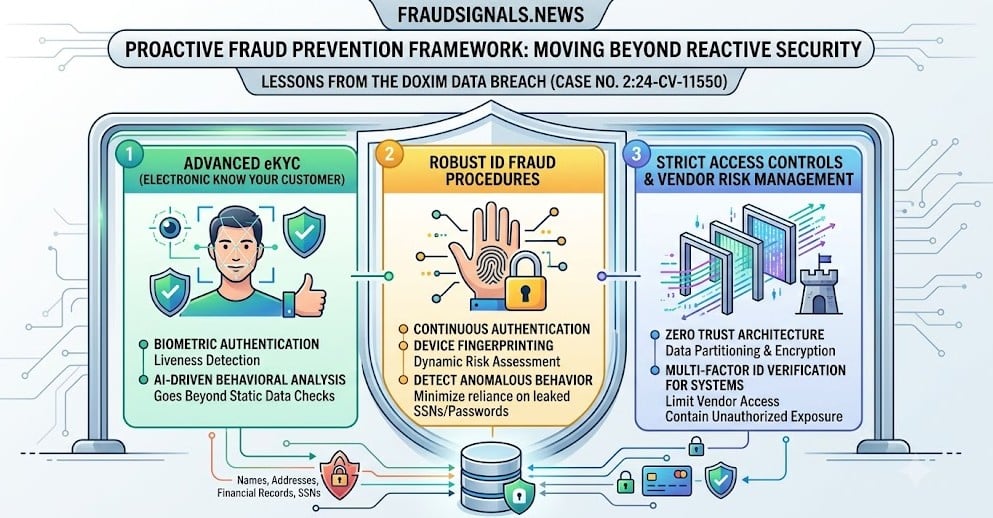
How can we prevent unauthorized actors from gaining access to client data in the future? The answer lies in modernizing identity infrastructure:
- Advanced eKYC Software: Electronic Know Your Customer (eKYC) platforms must move beyond simple point-in-time checks. Modern eKYC solutions utilize liveness detection, biometric authentication, and AI-driven behavioral analysis to ensure that the person accessing a network or an account is exactly who they claim to be.
- Robust ID Fraud Procedures: Relying on static passwords and security questions (which are easily bypassed once SSNs and addresses are leaked) is a recipe for disaster. Organizations must implement dynamic ID fraud procedures, such as continuous authentication and device fingerprinting, to detect anomalous behavior in real time.
- Strict Access Controls: Vendor risk management is critical. Data should be partitioned, encrypted at rest and in transit, and gated behind rigorous identity verification protocols so that a single compromised credential does not result in the mass exfiltration of financial records.
Data breaches will continue to plague the financial sector as long as organizations rely on legacy security frameworks. By investing in advanced identity verification and cutting-edge eKYC protocols, financial service providers can lock down their most valuable asset—their clients’ trust—and keep unauthorized actors locked out for good.
Disclaimer: FraudSignals.news is an independent publication dedicated to fraud prevention, cybersecurity, and identity verification. We are not affiliated with Doxim, the settlement administrator, or the United States District Court. For official legal information regarding the settlement, please visit www.doximdatasecuritysettlement.com.

Fraud Teams: NIST Aligned VPN Detection for Onboarding, Score First

Prevent a Biometric Breach: 6 Operational Controls for Identity Teams