

Remote identity verification is the digital process of authenticating an individual’s identity without physical presence, using biometric data, document scanning, and device intelligence to confirm who someone is. The industry term for this practice is “remote identity proofing,” a standard defined under frameworks like NIST Special Publication 800-63A. For compliance officers, fintech professionals, and individuals navigating digital onboarding, understanding what is remote identity verification means understanding the full stack of technologies, regulatory requirements, and fraud risks that shape every digital transaction today. Fraud Signals News covers this space in depth because the gap between strong and weak verification is exactly where fraud enters.
What is remote identity verification and how does it work?
Remote identity verification is defined as the process of confirming a person’s claimed identity through electronic means, without requiring that person to appear at a physical location. It combines document authenticity checks, biometric matching, liveness detection, and database cross-referencing into a single automated flow. Identity verification involves document authenticity checks, facial recognition, liveness detection, and cross-checking user data against external databases. That combination makes it far harder to spoof than any single-factor check.
The process typically starts when a user submits a government-issued ID through a mobile device or web browser. The system extracts data from the document, checks security features for tampering, and then compares the document photo against a live selfie. AI-powered systems can complete this validation in as little as 10 seconds, supporting over 16,000 document types across 200-plus countries. That global reach matters for any organization onboarding users internationally.

Device and network intelligence run in parallel, invisible to the user. Automated systems analyze device signals across 1,000-plus parameters, including IP reputation, browser behavior, and device fingerprinting, to detect synthetic identities that document checks alone would miss. This layer catches fraud patterns that no human reviewer would spot in real time.
When automated checks flag ambiguous cases, a human reviewer steps in. Human-supervised reviews are typically completed within 3 minutes, and hybrid models reduce false rejections while maintaining speed. This “human-in-the-loop” design is not a fallback. It is a deliberate architecture choice for high-assurance environments.
Core technologies in the verification stack
- Document scanning: Optical character recognition (OCR) extracts data fields; machine learning models check for font inconsistencies, hologram tampering, and microprint anomalies.
- Facial biometrics: A facial recognition algorithm compares the document photo to a live selfie, generating a similarity score above a defined threshold.
- Liveness detection: Passive liveness analyzes a single image for signs of spoofing; active liveness prompts the user to blink or turn their head. Scaling liveness checks based on risk profile optimizes both security and user convenience.
- Database cross-referencing: The extracted identity data is checked against credit bureaus, sanctions lists, and government databases to confirm the person exists and is not flagged.
- Device intelligence: IP analysis, browser fingerprinting, and behavioral signals flag anomalies before a human ever reviews the case.
Pro Tip: If you are evaluating a verification provider, ask specifically whether their liveness detection is certified under ISO 30107-3 Part 3. That standard is the benchmark for anti-spoofing performance, and providers without it are leaving a measurable gap in your fraud defenses.
How does remote verification meet compliance and security standards?
Regulatory compliance is not a byproduct of good verification. It is the primary driver for most organizations adopting remote identity proofing. Anti-money laundering (AML) regulations and Know Your Customer (KYC) requirements mandate that financial institutions confirm customer identities before opening accounts or processing high-value transactions. Remote verification automates that obligation at scale.
The most demanding compliance tier is NIST Identity Assurance Level 3 (IAL3). NIST IAL3 compliance requires supervised remote identity proofing for high-assurance environments, and software-only paths are explicitly insufficient. IAL3 is mandatory for federal credentialing and classified facility enrollment. That means any organization operating in those environments cannot rely on a fully automated flow, regardless of how accurate the AI is.
The reason supervised proofing remains mandatory at IAL3 is not bureaucratic caution. AI-generated deepfakes and synthetic identities have made older verification methods obsolete, and supervised proctor oversight with tamper-proof hardware is the current technical defense. A deepfake video can defeat passive liveness detection. A trained human reviewer with a live video feed is significantly harder to fool.
“Supervised remote identity proofing is the only reliable defense against AI deepfakes and synthetic identity fraud. Software-only verification paths, regardless of their AI sophistication, cannot meet the assurance bar required for high-stakes credentialing.”
Risk-based approaches address the compliance-versus-friction tension for lower-assurance use cases. Risk-based verification combines frictionless flows for low-risk users with deeper verification steps for suspicious or high-value actions. A first-time user opening a crypto wallet gets a different verification intensity than a returning user making a routine login. That tiered design keeps conversion rates high without lowering the security bar for genuinely risky transactions.
- Establish the assurance level required. Determine whether your use case falls under IAL1, IAL2, or IAL3 per NIST SP 800-63A. The level dictates the minimum verification controls.
- Map AML and KYC obligations. Financial institutions must align verification steps with FinCEN Customer Identification Program (CIP) rules and, where applicable, the EU’s AMLD6 requirements.
- Implement risk-based step-up verification. Route low-risk sessions through automated flows and trigger supervised review for high-risk signals like VPN use, device mismatch, or unusual transaction patterns.
- Document the verification record. Regulators require audit trails. Every verification event should log the document type, biometric match score, liveness result, and any human review outcome.
What are the differences between remote and in-person identity verification?
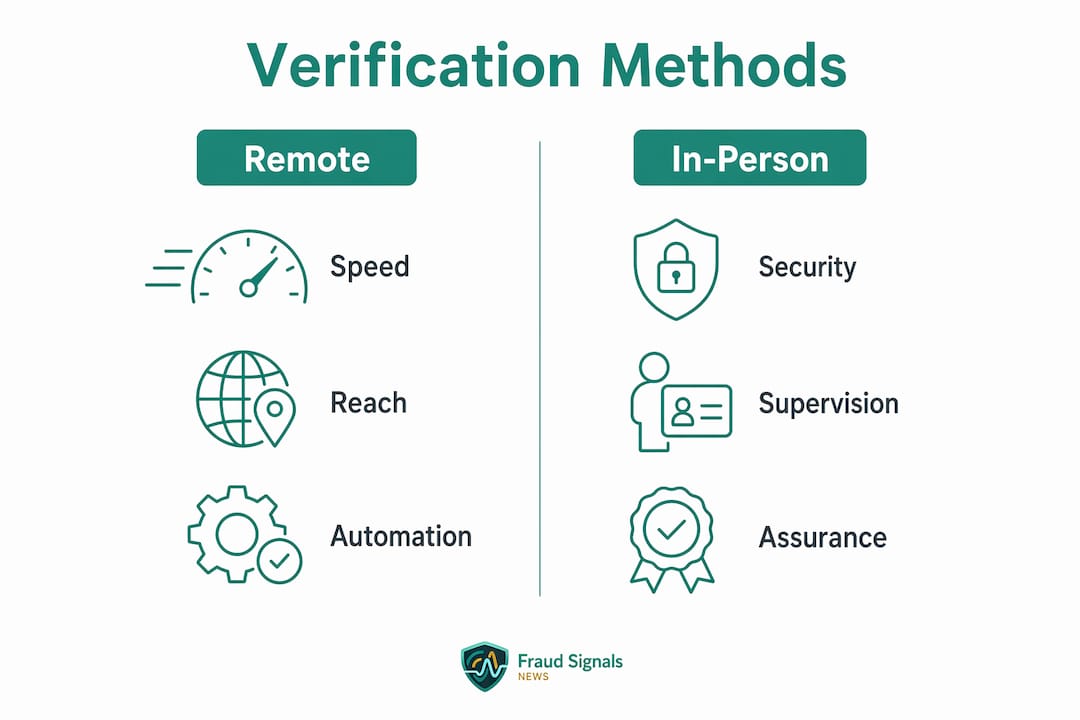
Remote and in-person verification solve the same problem through fundamentally different architectures, and neither is universally superior. The right choice depends on the assurance level required, the user population, and the operational context.
| Factor | Remote verification | In-person verification |
|---|---|---|
| Speed | Seconds to minutes | Minutes to hours |
| Geographic reach | Global, 24/7 | Limited to physical locations |
| Assurance ceiling | IAL2 (automated), IAL3 (supervised) | IAL3 with trained officer |
| User friction | Low to moderate | High |
| Fraud risk | Deepfake and synthetic ID risk | Physical document forgery risk |
| Cost per verification | Lower at scale | Higher due to staffing |
Remote verification wins on speed and reach. An organization onboarding users across 50 countries cannot staff physical verification centers in every market. Platforms using Assisted Image Capture achieve 95-plus percent first-pass success rates, which means the user experience is competitive with in-person processes for most populations.
The limitations of remote verification are real and should not be minimized. Poor lighting, low-resolution cameras, and unfamiliar document types all increase failure rates. Users face challenges like poor lighting or camera focus causing verification failures, and clear real-time feedback is the primary mitigation. Systems that tell users exactly what is wrong, rather than returning a generic error, recover most of those failed sessions.
In-person verification retains its advantage in the highest-assurance scenarios. A trained government officer examining a physical passport under UV light, with the applicant present, remains the gold standard for national security credentialing. Remote verification at IAL3 with supervised proofing approaches that standard but does not replace it for every context.
Pro Tip: For organizations running hybrid workforces or serving users in regions with inconsistent mobile hardware, consider offering both remote and in-person paths. Users who fail remote verification three times should have a clear escalation route rather than a dead end.
What are best practices for using remote identity verification effectively?
Strong remote identity verification requires discipline from both the organization deploying it and the individuals completing it. Most verification failures are preventable with the right guidance and system design.
For individuals completing verification:
- Use a well-lit environment with natural or overhead light directly on your face and document. Side lighting creates shadows that confuse facial recognition algorithms.
- Hold your document flat and steady. Camera autofocus struggles with curved or tilted documents, which triggers re-capture prompts.
- Remove glasses during the selfie capture. Lens glare creates a mismatch between the document photo and the live image.
- Follow real-time prompts exactly. Systems that provide real-time image quality feedback significantly improve success rates and reduce session abandonment.
For organizations deploying verification:
- Select providers with documented compliance certifications, including ISO 27001 for data security and ISO 30107-3 for liveness detection. Certifications are not marketing claims. They are audited controls.
- Require continuous platform updates as a contractual obligation. Multi-layered security using device intelligence and database cross-referencing must evolve as fraud tactics evolve. A provider that has not updated its deepfake detection models in 12 months is already behind.
- Integrate eKYC processes into your onboarding workflow from the start, not as a bolt-on step. Verification that feels disconnected from the user journey increases abandonment.
- Monitor verification analytics continuously. Unusual spikes in failure rates, specific document types, or geographic clusters signal either a fraud campaign or a UX problem. Both require immediate investigation.
- Build escalation paths for edge cases. Automated systems will encounter documents they cannot read and faces they cannot match. A clear human review queue prevents those cases from becoming permanent rejections.
The organizations that get remote verification right treat it as a living system, not a one-time implementation. Fraud tactics targeting biometric verification methods evolve continuously, and the verification stack must keep pace.
Key Takeaways
Remote identity verification combines biometric matching, document scanning, and device intelligence into a layered system that meets compliance standards only when the assurance level, fraud risk, and user experience are all addressed together.
| Point | Details |
|---|---|
| Core technology stack | Document scanning, facial biometrics, liveness detection, and device intelligence work together, not in isolation. |
| NIST IAL3 requires supervision | Software-only verification cannot meet IAL3; supervised remote proofing with human oversight is mandatory. |
| Deepfakes demand active defense | AI-generated synthetic identities have made passive liveness detection insufficient for high-risk environments. |
| Risk-based design balances friction | Low-risk users get frictionless flows; high-risk signals trigger step-up verification to maintain both speed and security. |
| User guidance drives success rates | Real-time feedback on lighting and document quality pushes first-pass success rates above 95%. |
The supervised proofing gap most organizations ignore
The part of remote identity verification that most organizations underinvest in is supervised proofing. I have watched compliance teams deploy fully automated verification flows, declare the KYC obligation met, and then discover months later that their fraud loss rates have not moved. The reason is almost always the same: they treated automation as the destination rather than the baseline.
Automated verification handles the easy cases well. It is the edge cases, the ambiguous documents, the faces that do not quite match, the device signals that are slightly off, where the real fraud hides. High-stakes compliance requires human-in-the-loop verification to handle ambiguous cases that AI misses, reducing false rejections and catching deepfakes. That is not a theoretical claim. It is the architecture that federal credentialing programs have built their requirements around.
The deepfake problem is accelerating this urgency. The quality of AI-generated faces has crossed a threshold where passive liveness detection alone is no longer a reliable barrier. Organizations that have not updated their liveness models or added supervised review for high-value onboarding are operating with a known gap. The fraud community knows it too.
My view is that the authentication technology conversation needs to shift from “how fast can we verify” to “how confident are we in the result.” Speed matters, but a 10-second verification that passes a synthetic identity is worse than a 3-minute supervised review that catches it. The organizations that understand that distinction are the ones building durable fraud defenses.
— A. Johnson
Fraud Signals News keeps you current on identity verification
Staying ahead of fraud in remote verification requires more than a one-time implementation. The threat environment changes faster than most compliance cycles.

Fraud Signals News publishes ongoing analysis of biometric fraud trends, regulatory updates, and verification technology developments that affect organizations across fintech, crypto, gaming, and enterprise sectors. The coverage goes beyond headlines to examine how specific fraud techniques exploit verification gaps and what technical responses actually work. For professionals responsible for identity verification programs, the compliance coverage at Fraud Signals News provides the context that vendor marketing does not. Visit Fraud Signals News to stay current on the standards, threats, and technologies shaping remote identity proofing in 2026.
FAQ
What is the difference between IAL2 and IAL3 verification?
IAL2 allows automated remote identity proofing with strong biometric and document checks, while IAL3 requires supervised remote proofing with a human proctor and tamper-proof hardware. IAL3 is mandatory for federal credentialing and classified facility access under NIST SP 800-63A.
How does liveness detection prevent fraud?
Liveness detection confirms that the biometric sample comes from a live person rather than a photo, video, or deepfake. Passive liveness analyzes a single image for spoofing artifacts, while active liveness prompts physical responses that are harder to fake with synthetic media.
What documents does remote identity verification accept?
Modern verification platforms support a wide range of government-issued documents, including passports, national ID cards, and driver’s licenses. Leading systems cover over 16,000 document types across 200-plus countries for global onboarding coverage.
Why do remote verification sessions fail?
The most common causes are poor lighting, low camera resolution, and document glare or tilt. Platforms that provide real-time feedback on image quality recover most failed sessions and achieve first-pass success rates above 95%.
Is remote identity verification legally valid for KYC compliance?
Remote identity verification satisfies KYC and AML requirements in most jurisdictions when it meets the applicable assurance level and maintains a documented audit trail. High-assurance environments, such as federal programs, require supervised proofing to meet NIST IAL3 standards.
Recommended

Biometric Performance Metrics: What to Measure and Trust

ID Security Features: What Each One Does and How to Check It