

Consent in identity verification is defined as the explicit, informed permission an individual grants before an organization collects, processes, or shares their personal data during a verification workflow. The role of consent in identity verification goes far beyond a legal checkbox. It is the mechanism that determines whether users trust a system, whether regulators approve it, and whether the data flowing through it is ethically defensible. Regulations like GDPR establish that consent must be freely given, specific, informed, and unambiguous. Organizations that treat consent as a formality rather than a governance control are building verification systems on a structurally weak foundation.
What is the role of consent in identity verification?
Consent functions as a transparency gate. Before any document scan, biometric capture, or data query begins, the user must understand what is being collected, why it is being collected, and how long it will be retained. GDPR-compliant KYC onboarding requires that a data collection disclosure screen appear before any camera or document capture is triggered. This is not optional. Skipping it exposes organizations to regulatory risk and, more practically, erodes the user trust that makes verification workflows function at all.
The importance of consent in verification is also operational. Consent-based verification models reduce verification timelines from days to minutes by allowing direct, authorized data access. That speed is only possible because the user has actively permitted the data flow. Without that permission, the organization cannot legally proceed, and the technical pipeline should not proceed either.

Consent and user identity are inseparable in regulated contexts. Anti-money laundering (AML) frameworks, for example, do not rely on consent as the sole legal basis for processing. But consent still governs the transparency layer. Users must know what is happening to their identity data even when the law compels the organization to verify them.
Granular consent and the right to withdraw
Consent must be granular. Separate consent is required for document scanning versus biometric matching. A user who agrees to upload a passport photo has not automatically agreed to facial recognition or liveness detection. Granular consent controls improve user trust and measurably reduce abandonment rates. Poorly designed consent flows that bundle unrelated permissions together damage brand perception and invite regulatory scrutiny.
Users also hold the right to withdraw consent. When withdrawal occurs, data processing must stop, and in most jurisdictions, previously collected data must be deleted or anonymized unless another lawful basis applies. Organizations that cannot honor withdrawal requests quickly are not operating a consent system. They are operating a data collection system with consent theater at the front.
Pro Tip: Design your consent withdrawal flow before you design your consent capture flow. If withdrawal is hard to build, it will be hard to honor, and that gap is where regulatory exposure lives.
- Consent must appear before any technical data capture begins
- Separate consent is required for each distinct data type (documents, biometrics, behavioral data)
- Withdrawal mechanisms must be as accessible as the original consent prompt
- Consent for identity verification must not be bundled with marketing permissions
- Users must receive plain-language explanations, not legal boilerplate
How do modern consent architectures work in 2026?
Consent architecture in 2026 treats consent as a governed identity event, not a UI element. Treating consent as a lifecycle control means capturing metadata at the moment of consent: the policy version the user agreed to, the timestamp, the jurisdiction, and the identity context. This metadata makes consent audit-ready. Without it, organizations cannot prove consent in regulatory audits or respond accurately to subject access requests.
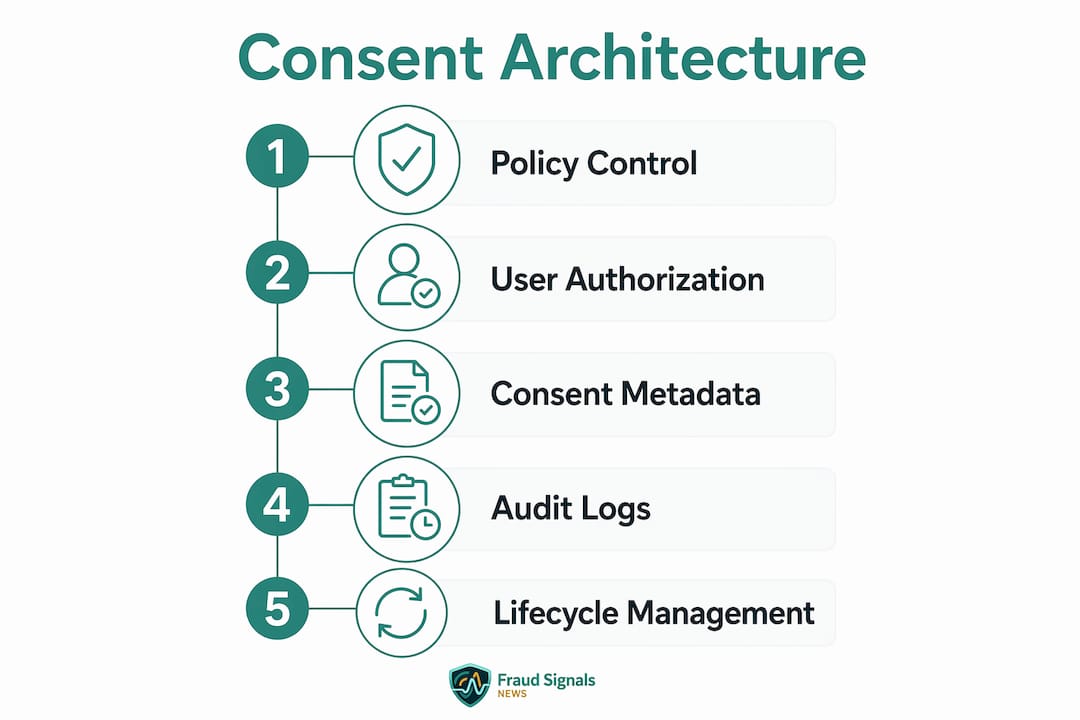
The technical implementation that best enforces this is the state machine model. Architecting consent as a state machine ties token issuance directly to active consent status. No consent means no token. No token means no data flows. This approach removes the gap between policy and practice that plagues checkbox-based systems.
Key components of a mature consent architecture
- Dynamic consent management. Consent management platforms (CMPs) integrate directly into identity verification flows and maintain a centralized, real-time permission view across all customer records.
- Purpose-specific separation. Modern consent architecture requires separating identity verification consent from unrelated uses like marketing or analytics. Bundling these is a compliance failure.
- Version control. When privacy policies change, the system must record which version each user consented to and prompt re-consent where required.
- Jurisdiction-aware policies. A user in California operates under CCPA. A user in Germany operates under GDPR. The consent system must apply the correct rules automatically.
- Audit trail generation. Every consent event must produce a durable, tamper-evident log that compliance teams can retrieve on demand.
| Consent architecture element | Function |
|---|---|
| Policy version control | Tracks which consent version each user accepted |
| Jurisdiction-aware rules | Applies correct legal framework per user location |
| Token-gated data flow | Blocks data processing when consent is absent or withdrawn |
| Centralized CMP | Maintains accurate permission view across all records |
| Audit trail | Provides durable proof of consent for regulatory review |
Pro Tip: Many organizations fail to bind consent metadata properly to the identity record. Run a quarterly audit that checks whether every active user record has a linked, timestamped consent event. Gaps in that audit are your regulatory liability.
What are the ethical challenges of consent in identity verification?
The ethical dimension of consent is where most organizations underperform. Poor consent design harms user autonomy and trust. Well-crafted consent flows maintain human dignity in digital decisions, particularly when AI-powered biometric methods like liveness detection and facial matching are involved. Users submitting a face scan to a financial institution are sharing something deeply personal. They deserve to understand exactly what happens to that data.
Consent fatigue is a real and measurable problem. When users encounter long, dense consent screens with no clear structure, they either abandon the process or click through without reading. Both outcomes are failures. Abandonment costs the organization a customer. Uninformed click-through creates a consent record that does not reflect genuine understanding, which is ethically and legally hollow.
“Purpose-specific transparency and UI/UX design are as important as legal compliance for ethical verification.” The technical and legal requirements of consent are necessary but not sufficient. The design of the consent experience determines whether users actually understand what they are agreeing to.
The risks of simplistic checkbox consent extend beyond ethics. Many organizations fail to bind consent metadata properly, making it impossible to prove consent in audits or respond to user requests. A checkbox with no metadata attached is not a consent record. It is a liability.
- Consent fatigue occurs when screens are too long, too dense, or too frequent
- Bundled consent (combining verification with marketing) is both unethical and non-compliant
- AI biometric methods require explicit, purpose-specific disclosure before capture
- Checkbox consent without metadata creates audit gaps that regulators will find
- Coercive consent, where users cannot access a service without agreeing to unrelated data uses, violates GDPR’s “freely given” standard
Fraud Signals News covers identity fraud risks that emerge directly from weak consent practices, including cases where organizations collected biometric data without adequate disclosure and faced both regulatory penalties and public trust collapse.
How should organizations implement effective consent in identity verification?
Effective consent implementation starts with disclosure design. A clear data collection disclosure screen must appear before any camera activation or document upload prompt. This screen must name the data types being collected, state the purpose, identify the retention period, and explain the user’s rights. Plain language is not optional. Legal boilerplate fails this test every time.
Consumer-permissioned verification models show what effective consent looks like in practice. Users actively authorize access to income and employment data, can revoke that access at any time, and experience faster verification as a result. The administrative burden on the organization drops because the user controls the data pipeline. This model respects users as active participants rather than passive subjects.
Organizations building biometric verification systems must pay particular attention to how consent affects identity data at the point of capture. Liveness detection and facial matching require separate, explicit consent from document verification. Combining them under a single permission is a design failure with legal consequences.
Pro Tip: Implement a “no consent, no token” enforcement model at the API layer. When a user’s consent record is absent, expired, or withdrawn, the identity token should not issue. This makes consent enforcement automatic rather than dependent on manual process checks.
- Present a plain-language disclosure screen before any biometric or document capture
- Offer granular consent options so users can agree to verification without agreeing to secondary uses
- Build consent withdrawal into the user account interface, not just the legal terms page
- Use a CMP that integrates directly with your identity verification API to enforce consent state in real time
- Store consent records with full metadata: timestamp, policy version, jurisdiction, and identity context
- Test your consent flow with real users and measure abandonment rates at each step
eKYC workflows that integrate consent management platforms at the API layer consistently outperform those that treat consent as a front-end-only concern. The difference is enforcement. A consent record that does not block data flow when withdrawn is not a governance control. It is documentation.
Key Takeaways
Consent in identity verification is a lifecycle governance control, not a front-end formality, and organizations that treat it otherwise face both regulatory exposure and measurable user trust failures.
| Point | Details |
|---|---|
| Consent is a transparency gate | Disclosure must appear before any document or biometric capture begins. |
| Granular consent reduces abandonment | Separate permissions for documents and biometrics improve trust and compliance. |
| Metadata makes consent audit-ready | Timestamp, policy version, and jurisdiction must be captured at the consent event. |
| No consent, no token enforcement | Linking token issuance to active consent state closes the gap between policy and practice. |
| Consumer-permissioned models work | Giving users active control over data access speeds verification and reduces administrative burden. |
Why consent architecture is the real differentiator
I have watched organizations spend significant resources on biometric accuracy and fraud detection while treating consent as an afterthought. The pattern is predictable. A sophisticated liveness detection system sits behind a consent screen that was written by a lawyer and never tested with a real user. Abandonment spikes. Regulators ask questions. The organization scrambles to retrofit a consent management platform into a system that was never designed to accommodate one.
The organizations that get this right build consent architecture before they build the verification flow. They treat consent as a governed identity event from day one, which means every consent record carries metadata, every policy change triggers a re-consent workflow, and every withdrawal is technically enforced at the token layer. That is not overcompliance. That is the minimum viable standard for operating a biometric verification system in 2026.
The deeper point is that consent is where user trust is either earned or lost. A user who understands exactly what data is being collected, why, and for how long is a user who completes the verification process. A user who faces a wall of legal text before a face scan is a user who abandons. The biometric compliance standards that govern these systems are increasingly specific about consent requirements, and the organizations that have invested in consent UX are the ones that meet those standards without emergency remediation projects.
Consent is not a compliance cost. It is the architecture that makes ethical digital identity possible.
— A. Johnson
Consent and compliance resources at Fraud Signals News
Fraud Signals News tracks the intersection of identity verification technology and regulatory compliance, covering everything from GDPR enforcement actions to the latest developments in biometric consent standards.
For organizations building or auditing their verification workflows, the compliance coverage at Fraud Signals News provides ongoing analysis of consent governance, eKYC regulation, and biometric data law. The authentication and identity sections cover technical implementation in depth. Fraud Signals News publishes reporting that helps compliance teams, product managers, and security architects stay ahead of the regulatory curve without wading through primary source documents alone.
FAQ
What is the role of consent in identity verification?
Consent is the mechanism by which users authorize the collection and processing of their personal data before verification begins. It functions as both a legal requirement under frameworks like GDPR and a transparency control that governs what data is collected, for what purpose, and for how long.
Why does consent matter for biometric identity verification?
Biometric data is classified as sensitive personal data under GDPR and similar regulations, requiring explicit, purpose-specific consent before capture. Facial matching and liveness detection require separate consent from document verification because they involve distinct data types with different risk profiles.
What is a “no consent, no token” enforcement model?
This model links identity token issuance directly to an active, valid consent record. When consent is absent, expired, or withdrawn, the system does not issue a token, which technically blocks all downstream data processing and enforces consent governance at the API layer.
How does consent withdrawal work in identity verification?
Users can revoke consent at any time, which must trigger an immediate halt to data processing and, in most jurisdictions, deletion or anonymization of previously collected data. Organizations must build withdrawal mechanisms that are as accessible as the original consent prompt.
What makes a consent record audit-ready?
An audit-ready consent record captures the policy version the user agreed to, the timestamp of consent, the jurisdiction, and the identity context. A checkbox with no attached metadata does not constitute a valid consent record for regulatory purposes.
Recommended

ID Security Features: What Each One Does and How to Check It

Face Liveness Detection: How It Works and Where It Fails