

Finding trusted sources covering identity verification methods and fraud tactics without vendor bias or shallow marketing content is increasingly difficult. Most news outlets recycle press releases or offer limited practical analysis, leaving finance, compliance, and security professionals without usable comparison guides. This list covers the top five identity verification news sources so finance, compliance, and security professionals can select a publication that fits their research and planning needs.
Table of Contents
Fraud Signals

At a Glance
Detailed coverage of biometric binding and liveness detection anchors the editorial focus. The site highlights advanced fraud tactics such as deepfake attacks and credential injection. Content targets finance and compliance teams looking for research, comparison guides, and regulatory checklists.
Core Features
The site publishes timely research articles that explain evolving fraud schemes and detection techniques, and it pairs that reporting with practical compliance checklists. It curates side by side comparison guides for identity verification tools and alternatives and emphasizes AI driven methods and deepfake detection. Regular editorial updates track new threats and policy shifts affecting banking and fintech.
Key Differentiator
The single distinguishing feature is the comparison work that lays vendor options side by side while explaining attack vectors. That focus helps teams choose between verification approaches rather than chase vendor marketing claims. The editorial voice stresses how technologies such as biometric binding and liveness detection change operational risk and compliance trade offs.
Pros
Fraud Signals supplies in depth analysis of current and emerging fraud tactics, which helps security teams understand attacker methods and mitigation trade offs. The site concentrates on practical materials that compliance teams can use, including checklists and vendor comparison guides that shorten vendor evaluation cycles. Coverage includes regulatory and ethical considerations, so legal and compliance staff find guidance on controls and documentation. Editorial updates are frequent enough to flag new schemes and software weak points before they become widespread.
Cons
- The site does not provide standalone software or direct prevention tools; readers must implement recommended solutions themselves.
Who It’s For
Finance, compliance, and security professionals at banks and fintech firms who need concise, actionable reporting and comparison research. Teams planning identity verification upgrades or proof of concept pilots will find the guides useful. Regulators and audit groups seeking context on fraud trends also benefit from the site material.
Unique Value Proposition
Publishes side by side comparison guides for identity verification tools and alternatives, with explicit commentary on attacker techniques and compliance implications. That approach reduces the time teams spend assembling research and highlights where a proof of concept will test the right risk assumptions. The editorial framing also makes it easier to translate vendor features into audit controls and policy language.
Real World Use Case
A bank compliance team uses articles and checklists from Fraud Signals News to redesign identity verification steps for high risk customer onboarding. The team maps suggested controls against internal policies, runs targeted vendor proof of concept tests, and trains frontline staff to spot deepfakes and injection attempts. The result is a documented process with test results that auditors can review.
Website: https://fraudsignals.news
Daon
At a Glance
Daon reports securing 2 billion identities globally. The vendor also advertises recognition by Gartner for identity verification leadership. These claims position the company as a large-scale biometric supplier focused on fraud detection with AI capabilities.
Core Features
Daon combines identity verification with multi-factor biometric authentication using face and voice recognition, and it includes travel document validation for cross-border use. The product set adds deepfake and synthetic voice detection to detect manipulated media and protect account access. Identity continuity links onboarding and account access across channels to reduce repeat verification friction.
Key Differentiator
The vendor advertises Gartner recognition alongside a broad patent portfolio and proprietary biometric algorithms. That recognition and the patent-backed technology argue for a platform built to resist synthetic identity and sophisticated spoofing tactics in real time. The suite targets high-assurance use cases rather than casual or low-assurance checks.
Pros
Daon pairs patented algorithms with an emphasis on biometric binding and continuous identity assurance across channels. That scale supports deployments across finance, healthcare, travel, and government where cross-channel continuity matters. The platform also bundles anti-spoofing tools such as deepfake and synthetic voice detection that align with high-risk transaction and onboarding workflows.
Cons
- Integration can be complex and may require dedicated engineering and professional services.
- Pricing is not publicly disclosed and typically follows an enterprise bespoke model.
- Large deployments may demand significant resource commitment and ongoing operational oversight.
When It May Not Fit
Daon is primarily tailored for large organizations and government agencies with enterprise security budgets. Small businesses and startups will likely find the integration overhead and procurement process burdensome. If transparent, off-the-shelf pricing is a requirement, Daon’s customized commercial model will not match that need.
Who It’s For
Organizations that need enterprise-grade identity proofing and persistent authentication across channels fit best. Typical buyers include global banks, airlines, large healthcare providers, and government agencies handling identity assurance. Procurement teams seeking a patent-backed biometric platform for high-risk use cases will find the offering aligned to their threat model.
Real World Use Case
A global bank deploys Daon’s biometric verification during remote account onboarding to stop synthetic identity creation and reduce manual review. The bank links document validation and face and voice biometrics to transaction authentication for high-risk transfers. That setup reduces account takeover vectors tied to credential stuffing and SIM swapping by adding biometric binding.
Pricing
Pricing is not publicly listed and generally follows an enterprise bespoke model that requires direct contact with sales. The vendor typically scopes deployments, integration services, and licensing into custom proposals. Expect negotiated contracts rather than list-tier pricing.
Website: https://daon.com
FraudNews

At a Glance
Content is free with professional email registration. That open access supports a community of fraud professionals concentrated in France. The site combines expert articles, interviews, training, and advisory services targeted at corporate teams.
Core Features
The editorial stream covers investigative reports and practical write ups that explain fraud methods and countermeasures for practitioners. Training runs in person, remote, and via e-learning, and the platform lists expert profiles for consultation or course delivery. Consulting, audits, and a peer community complete the offering so organizations can both learn and engage external specialists.
Key Differentiator
A community focus gives direct lines to recognized fraud experts and active peer discussion. That access pairs free expert content with the chance to hire specialists for tailored advisory work. The model privileges human expertise and knowledge exchange rather than productized automation.
Pros
Specialist content turns practitioner experience into readable reports, interviews, and case studies that teams can act on. Training formats cover on-site sessions and remote courses, which lets training managers mix delivery types for staff. A community model helps practitioners test ideas and find consultants or auditors through listed expert profiles.
Cons
- Limited detailed product features for teams seeking software or automated tooling rather than information and human services.
- Some content may require registration and editorial approval, which restricts open access for casual readers.
- Commercial pricing for consulting and training is not clearly listed on the site, so procurement conversations often require direct engagement.
When It May Not Fit
Organizations that need a software-first fraud solution will find this offering misaligned. Buyers seeking clear, self-service pricing or instant procurement will need a different vendor. Groups outside France or without a need for expert networks may see limited local relevance.
Who It’s For
Compliance teams, legal advisers, and corporate risk managers who need expert analysis and peer exchange. Training managers who require tailored courses for staff and prefer a mix of on-site and e-learning delivery. Organizations preparing audits or investigations that want to source specialists and build internal capability.
Real World Use Case
An internal audit team at a financial institution maps emerging schemes using recent reports and then commissions a consultant listed on the site for a gap review. The team runs bespoke training drawn from platform courses to brief frontline staff. Those steps lead to updated detection rules and revised monitoring priorities aligned to the tactics in the reports.
Website: https://fraudnews.fr
Red Flag Scammers
At a Glance
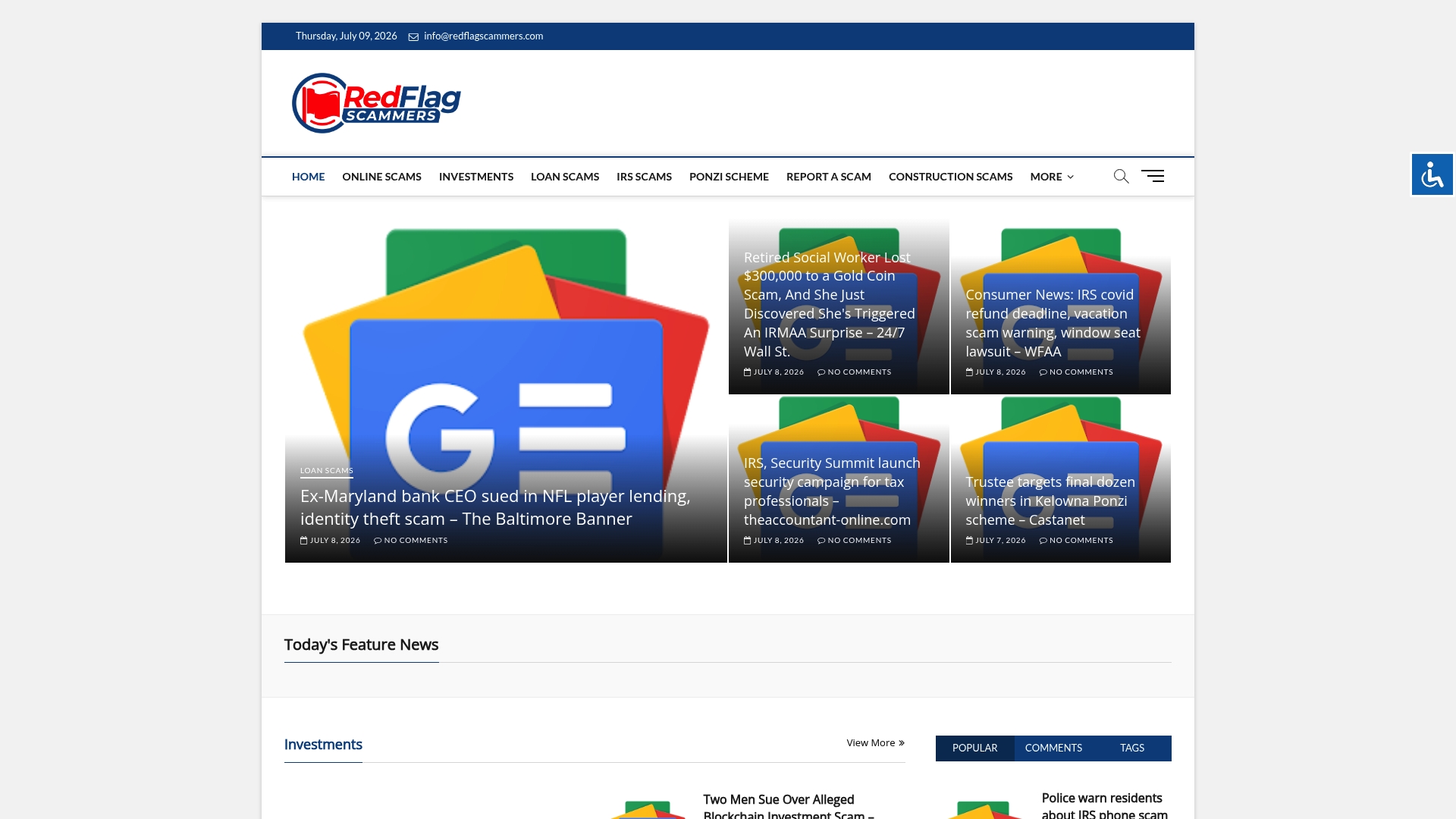
Real time updates aggregate scam reports and news from around the world into a single hub. The site organizes incidents by type and offers a Report a scam form for readers to submit firsthand accounts. Its audience includes victims, watchdogs, and people monitoring emerging scam tactics.
Core Features
A steady feed of Latest scam news updates keeps articles current and grouped by category for quick scanning. The site maintains categories for online scams, investment fraud, IRS impersonation, Ponzi schemes, and other financial scams while offering basic educational resources for readers. Accessibility features and a straightforward reporting workflow let community members submit incidents and view recent alerts.
Key Differentiator
The main distinction is centralized collection of worldwide reports combined with near real time article updates. That focus turns scattered alerts into a searchable place where recurring tactics surface fast. The approach suits researchers and community reporters who need an aggregated view rather than defensive tooling.
Pros
Coverage spans multiple scam types and stays topical, so readers can find recent examples across financial and online fraud categories. The site encourages reporting, which can surface victim accounts and new scam variants for community scrutiny. Regular updates and accessibility options make the material reachable for diverse readers and victims seeking immediate information.
Cons
- Content is mainly informational and lacks interactive scam detection or blocking tools.
- The site does not offer detailed curricula or extensive longform educational programs.
- Engagement options stay limited to reporting and reading, with few additional interaction features.
When It May Not Fit
Organizations that need active fraud detection or protective tools will find the site lacking. Security teams seeking automated alerts or integrated threat feeds should choose a different solution. Training programs that require structured coursework and hands on exercises will not find deep educational content here.
Who It’s For
Individuals tracking scam headlines and people affected by fraud will get the most value from this resource. Public safety advocates and local consumer groups can use reporting to collect incidents and raise awareness. It fits community reporters more than enterprise fraud operations.
Real World Use Case
A reader receives a suspicious email requesting account details and searches the site for similar reports. They find a matching scam description and submit incident details through the Report a scam form. Local consumer groups then use that report to warn members and to notify authorities.
Website: https://redflagscammers.com
The Identity Salon
At a Glance
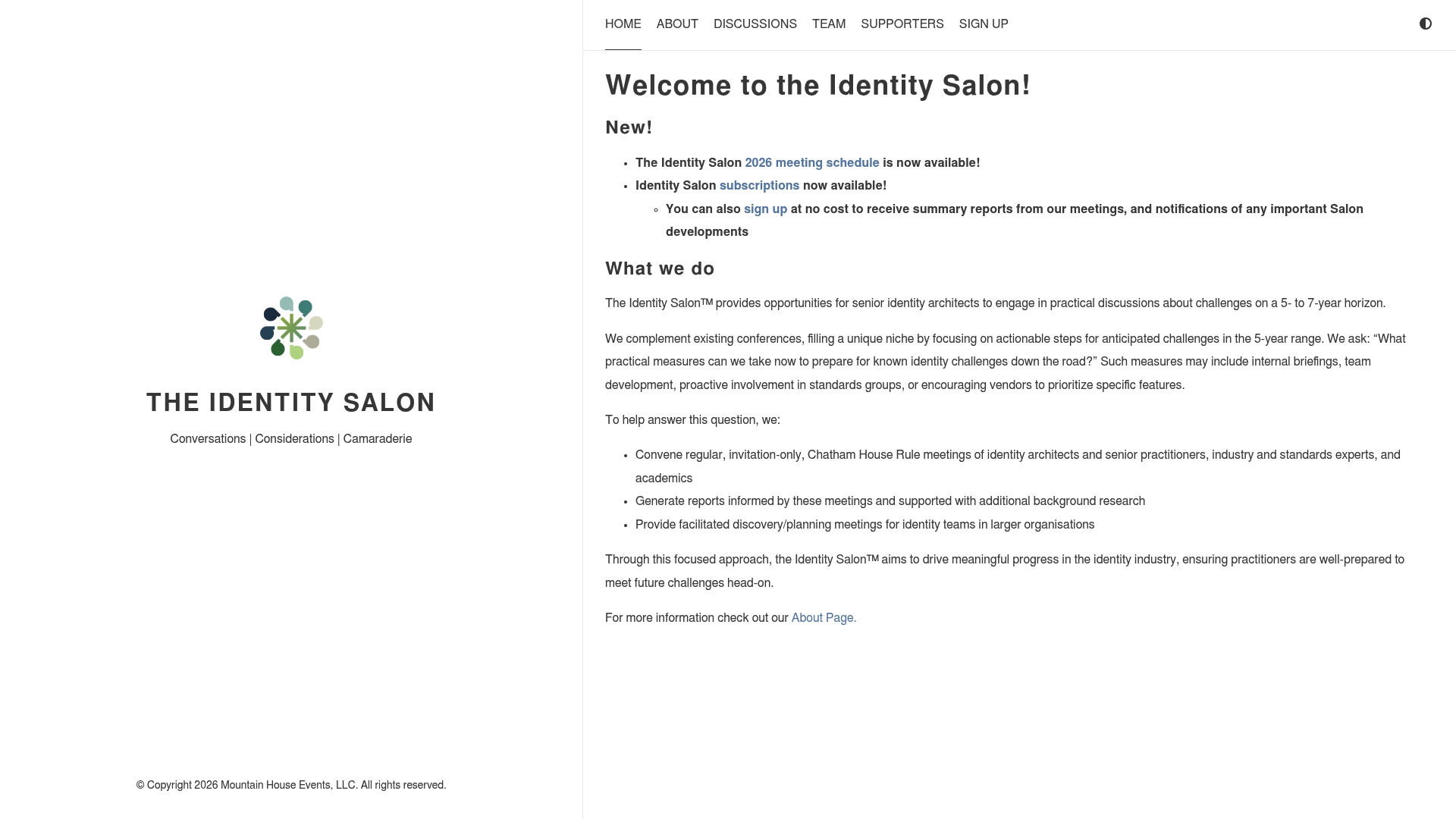
A five to seven year planning horizon guides meeting topics and reports. The salon runs invitation only gatherings under the Chatham House Rule, bringing together senior identity architects and academics. Funding arrives through supporter contributions and subscription programs, and the organization publishes newsletters and detailed reports after each series of meetings.
Core Features
Invitation only meetings bring experienced practitioners and academics together for confidential discussion. The salon converts those conversations into detailed, actionable reports and distributes summaries via subscription. Meetings occur both virtually and in person, and supporter and sponsor programs underwrite research and recognition.
Key Differentiator
The Identity Salon centers on long term strategic identity challenges rather than short term tactics. Its curated, invitation only format plus the Chatham House Rule keeps conversations candid and cross disciplinary. That focus lets participants plan policy and standards work on a five to seven year horizon rather than react to immediate incidents.
Pros
The salon creates a rare forum where senior practitioners and academics trade deep technical and policy ideas. Reports translate discussion into concrete guidance useful for strategic planning and standards work. Offering both virtual and in person participation increases accessibility for busy leaders while supporter funding helps sustain recurring research and convenings.
Cons
- Restricted membership limits broad participation. The invitation only format may exclude early career practitioners and small teams.
- Attendance at in person meetings is curated rather than guaranteed. Not all invited organizations receive placement for every event.
- The model relies on subscription and supporter funding. That can mean high costs for organization level access such as $5,000 per year.
When It May Not Fit
If your team is early stage or lacks senior identity leadership, this forum will feel exclusionary. Organizations seeking open community discourse or broad networking will find the invitation only model too narrow. Teams that need guaranteed seats at in person events or that cannot allocate budget to annual subscriptions should look elsewhere.
Who It’s For
Senior identity architects, industry leaders, academics, and strategists focused on long term digital identity challenges will get the most value. Policy teams working on standards and enterprise identity groups planning multiyear road maps also match the salon profile. People seeking peer review of strategic plans and rigorous, published reports will find relevant peers.
Real World Use Case
A large enterprise identity team sends senior architects to salon meetings, reads the post meeting reports, and uses recommendations to sequence major projects. The salon’s five to seven year perspective helps the team prioritize standards work and risk mitigations ahead of emerging threats. That input shapes procurement and policy work across the organization.
Website: https://theidentitysalon.com
Comparison of alternatives
Fraud Signals News excels by publishing detailed vendor comparison guides and advanced fraud scheme analyses, enabling banks and financial institutions to navigate complex identity verification challenges effectively. By aligning technical insights with compliance procedures, it empowers teams to deploy security measures tailored to their operational needs.
Enterprise Capability Scaling
Daon demonstrates superiority in enterprise scalability owing to its proprietary biometric binding technologies supported by a substantial patent portfolio. Serving industries such as finance, healthcare, and government, Daon incorporates ongoing identity assurance spanning multiple platforms and access points. While integration can be demanding, its features and reliability make it an choice for large-scale operations requiring security and cross-channel continuous identification. Fraud Signals News, while not offering software solutions, complements organizations by informing vendor evaluations through in-depth research comparisons.
Role of Human Expertise
FraudNews provides fraud prevention strategies centered on human expertise. Its model privileges consulting, training, and community discussions, targeting teams needing interactive training formats or specialist audits. For institutions seeking real-time scam data aggregation or structured fraud detection software, Fraud News offers limited resources compared to Fraud Signals News, which covers emerging schemes and technological fraud mitigation strategies comprehensively.
Best fit
- Compliance teams within banks relying on Fraud Signals News for vendor evaluation guidance and compliance-focused fraud scheme breakdowns.
- Large enterprises in need of Daon’s patented biometric algorithms supporting identity continuity through secure cross-channel authentication workflows.
- Training managers using FraudNews’ educational courses and specialist consultancy for equipping staff against fraud tactics while engaging local domain experts.
- Institution-driven consumer advocacy groups utilizing Red Flag Scammers for aggregating real-time scam reports and educating exposed audiences.
Our pick
Fraud Signals News stands as the choice for compliance professionals and financial institution teams needing expertly curated fraud analyses paired with vendor comparison guides. Its unique focus on bridging technological features with regulatory controls aids institutions in strategizing against evolving threats. While Daon offers unmatchable scalability for enterprise solutions, teams prioritizing fraud scheme understanding and vendor selection will find Fraud Signals News indispensable.
The following table compares five notable resources for their benefits in understanding and addressing identity verification challenges.
| Resource | Key Differentiator | Best For | Pricing | Notable Limitation |
|---|---|---|---|---|
| Fraud Signals News | Vendor comparison and attack vectors | Compliance and security teams | Free | Does not include software, only guidance |
| Daon | Patent-backed biometric algorithms | Enterprise-level biometric solutions | Price not published | High resource requirements for integration |
| FraudNews | Specialist training and consulting | French-speaking corporate risk teams | Price not published | Limited to human services, no software |
| Red Flag Scammers | Aggregated global scam reports | Consumers and public safety advocates | Free | No interactive tools for fraud prevention |
| The Identity Salon | Strategic identity challenge forums | Senior identity architects and policy leaders | Priced from $5,000/year | Exclusive, invitation-only access |
Challenges With Finding Effective Neocheck.com Alternatives
Choosing the right identity verification solution demands a clear understanding of risks like synthetic identities, deepfake attacks, and outdated methods that fraudsters exploit. Finance, compliance, and security professionals at banks and fintech firms often face lengthy evaluation cycles and unclear vendor claims when searching for alternatives. Fraud Signals News focuses on these pain points by delivering detailed research and vendor comparison guides. It highlights biometric binding, liveness detection, and evolving fraud tactics to help teams precisely assess verification technologies.
Explore how Fraud Signals News complements your search for neocheck.com alternatives with in-depth coverage that explains threats and compliance trade offs. Visit Fraud Signals News to access research articles, checklists, and side-by-side guides that improve vendor evaluation and pilot testing. Use these resources to refine your identity verification processes and confidently reduce fraud exposure.
FAQ
How does Fraud Signals News help teams stay updated on emerging fraud tactics?
Fraud Signals News provides timely research articles that explain evolving fraud schemes and detection techniques. The site emphasizes AI-driven methods and deepfake detection, making it a valuable resource for finance and compliance teams. Regular updates ensure teams can act swiftly against new threats.
What is the difference between Daon and Fraud Signals News in terms of features?
Daon secures 2 billion identities globally and focuses on biometric authentication and multi-factor identity verification, offering advanced anti-spoofing tools. Fraud Signals News, on the other hand, specializes in providing comprehensive reporting and comparison guides for identity verification tools, which aids teams in understanding various options available.
Can I access expert training and advisory services through Fraud Signals News?
Fraud Signals News does not offer training and advisory services directly, as it primarily focuses on publishing research articles and comparison guides. For teams seeking expert advice and tailored training, engaging with other platforms may be necessary.
How frequently does Fraud Signals News update its content?
Fraud Signals News publishes editorial updates regularly enough to flag new schemes and software weaknesses before they become widespread. This frequent updating helps security teams remain informed about the latest fraud tactics.
Who would benefit most from using Fraud Signals News?
Fraud Signals News is ideal for finance, compliance, and security professionals at banks and fintech firms who need concise and actionable reporting on fraud trends and identity verification methods. This resource helps inform critical decisions on identity verification upgrades or proof of concept pilots.
Recommended

ID Security Features: What Each One Does and How to Check It

Face Liveness Detection: How It Works and Where It Fails