
Comparing identity verification software that meets regulatory and operational needs is tedious for compliance teams and security professionals. Many platforms offer limited regional coverage, lack public pricing, or demand extensive engineering resources to integrate advanced features. This comparison details workflow integration, document support, and compliance alignment across five alternatives so compliance teams can match a platform to their risk and deployment profile.
Table of Contents
VeriFace
At a Glance
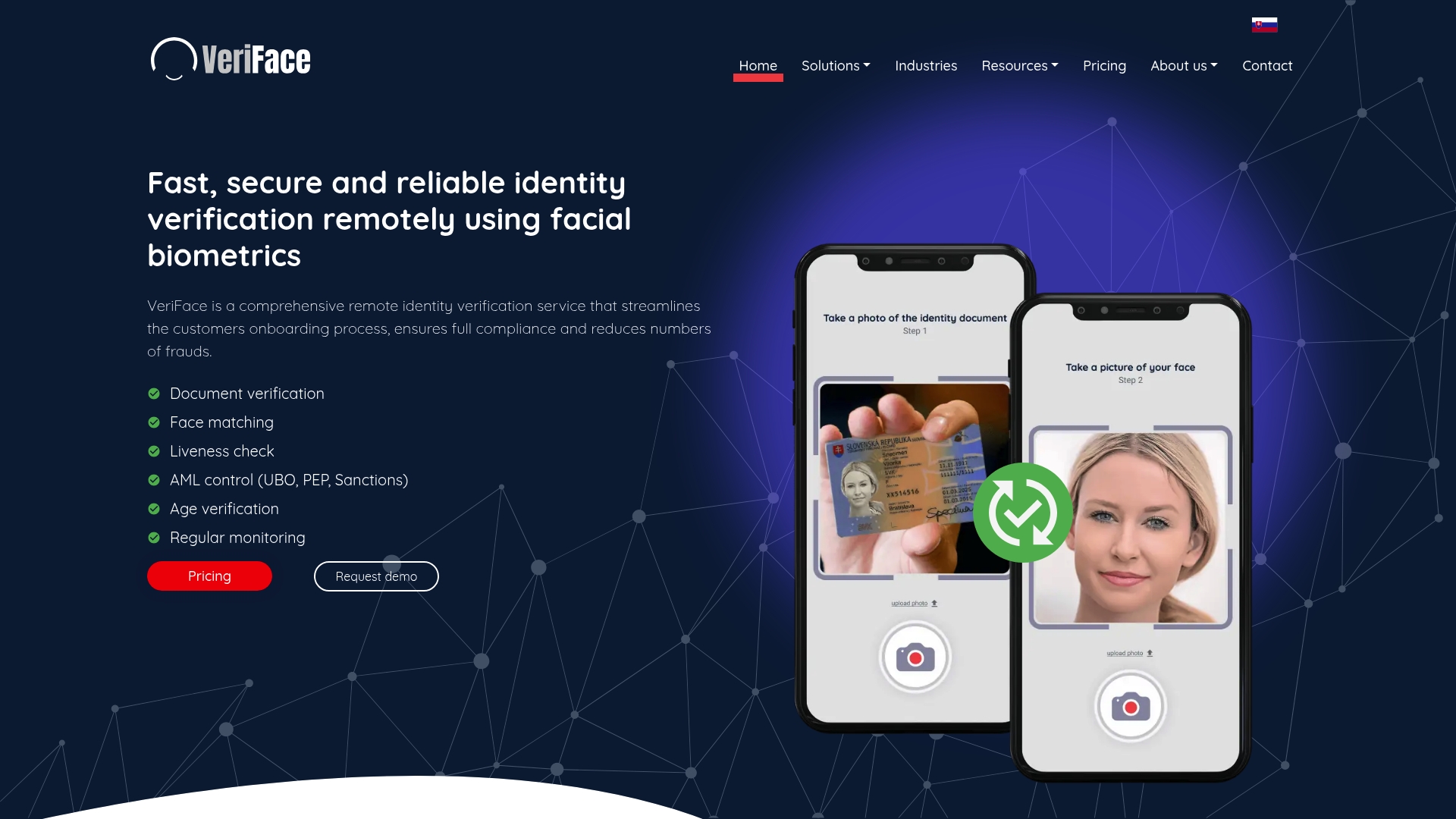
VeriFace starts at €2.05 per verification for standard packages, a concrete figure the vendor advertises for basic checks. The vendor states VeriFace maintains GDPR and anti-money laundering compliance. That positioning targets regulated sectors that need remote verification and ongoing monitoring.
Core Features
VeriFace matches ID documents to a live selfie while running a face matching algorithm and a liveness check. The service offers document verification, AML and KYC controls, age verification, real-time checks, and ongoing monitoring via API, SDKs, and cloud deployments. Integration options support both direct API calls and embeddable SDKs for web and mobile flows.
Key Differentiator
VeriFace emphasizes multi-modal verification that combines biometric face matching, document validation, and AML checks through flexible API and SDKs. That blend lets teams centralize identity, compliance, and monitoring in one pipeline rather than gluing separate vendors together.
Pros
VeriFace runs a fast verification flow that vendors claim is powered by AI, which reduces manual review for common document and selfie mismatches. Integration comes through SDKs and a REST API, so engineering teams can embed checks without rebuilding capture workflows. The product supports real-time and scheduled monitoring, which helps compliance teams keep watch over flagged identities and changing document status.
Cons
- Limited pricing transparency beyond the advertised starting price of €2.05 per verification.
- Not suited for in-person identity checks that require physical presence or biometric enrollment.
- Implementation complexity may rise when fitting into legacy systems or strict audit controls.
- Third-party reviews suggest careful implementation is required to meet data security and compliance needs.
When It May Not Fit
Organizations that require in-branch or kiosk identity capture will find VeriFace misaligned with those needs. Teams without developer resources or with minimal engineering capacity may struggle with integration and customization. Buyers seeking fully managed, offline identity proofing should look elsewhere.
Who It’s For
Financial services, online gambling operators, e-commerce platforms, and regulated product sellers that need remote, compliance-focused identity checks will find VeriFace relevant. The product suits teams that can allocate engineering time to integrate SDKs or API endpoints and that need ongoing monitoring tied to KYC and AML workflows.
Real World Use Case
A digital bank embeds the VeriFace SDK in its onboarding flow to verify documents and match selfies to IDs. That implementation reduces manual KYC steps and provides a monitored verification record for audit reviews.
Pricing
The vendor advertises subscription options and pay-per-verification billing, with the standard entry price of €2.05 per verification. Additional services such as document validation, AML control, and monitoring carry extra fees and are quoted on contact.
Website: https://veriface.eu
Verifai
At a Glance
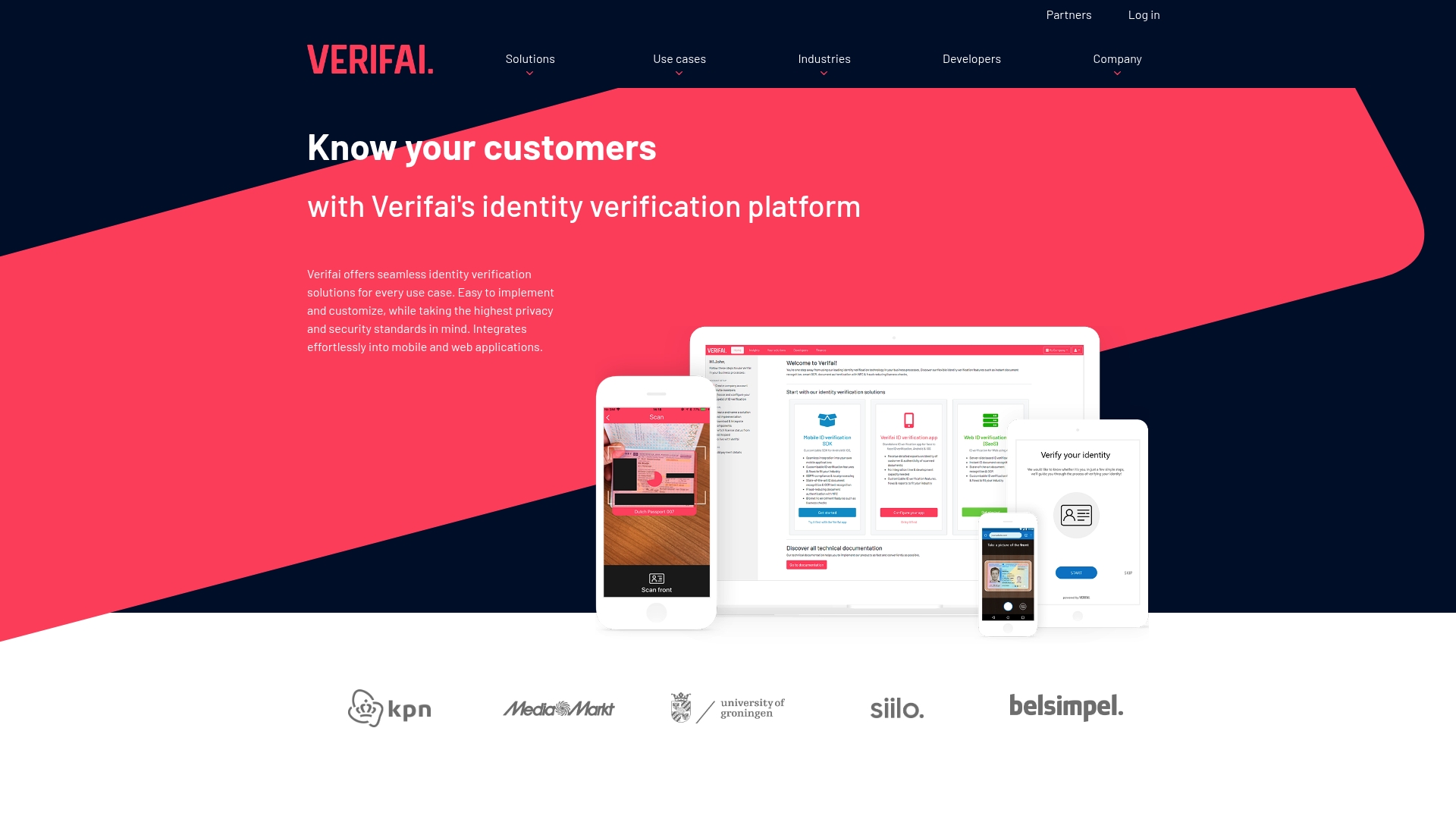
Verifai reports support for over 2,000 identity documents across more than 140 countries. The platform pairs document checks with biometric face matching and NFC chip validation for biometric IDs. It targets mobile and web workflows with SDKs and ready-to-use mobile apps for faster deployments.
Core Features
Verifai performs identity document verification and extracts structured data from images and scans, and it runs biometric facial verification alongside NFC chip validation for biometric passports and IDs. The product offers reusable SDKs for iOS, Android, and web, plus ready-made mobile apps to accelerate integration. The backend processes run in the Netherlands, and the platform uses 256-bit SSL encryption for data in transit.
Key Differentiator
The defining strength is broad global document coverage combined with customizable SDKs and fraud detection features. That combination lets engineering teams handle rare country documents without building custom parsers. The platform emphasizes configurable verification flows to match different risk profiles.
Pros
The vendor states the platform is GDPR compliant and highlights privacy and encryption as core controls, which matters for regulated sectors. Flexible integration options let teams choose SDKs, APIs, or out-of-the-box mobile apps for faster rollout. Industry templates and an operations dashboard provide reporting and case review to help operations teams monitor verification performance.
Cons
- Potentially steep setup for non-technical teams. Some third-party reviews note a learning curve for SDK and API integration.
- Pricing is not publicly listed. Organizations must contact Verifai for a quote.
- Advanced or custom verification workflows may require engineering time to configure and maintain.
When It May Not Fit
Small teams without engineering capacity will struggle with initial integration and complex workflows. Organizations that need fully transparent, self-serve pricing may find the contact-for-quote model inconvenient. Companies wanting a plug-and-play hosted verification product with minimal developer involvement should evaluate alternatives with turnkey onboarding.
Who It’s For
Verifai fits businesses that need global ID coverage and have engineering resources to integrate SDKs or APIs. Typical buyers include banks, fintechs, healthcare providers, transportation firms, and larger e-commerce platforms handling regulated checks.
Real World Use Case
A fintech startup integrated Verifai SDKs into its onboarding app to perform instant document scans, NFC chip checks during in-person visits, and biometric face matches for KYC. The setup replaced manual review steps and fed verification results into the startup’s risk engine for automated accept or escalate decisions.
Pricing
Pricing details are available on request. Verifai requires direct contact for quotes and does not publish standard tier pricing, so procurement teams should plan for an RFP or a pricing discussion during vendor evaluation.
Website: https://verifai.com
DAON
At a Glance
Daon is an enterprise identity verification and biometric authentication platform built for organizations that need to confirm who someone is at onboarding and keep confirming it across every channel afterward. Positioned as “The Digital Identity Trust Company,” Daon combines document verification, facial and voice biometrics, liveness checks, and deepfake detection inside a single orchestration layer. It serves regulated sectors — banking, public sector, healthcare, telecom, and travel — where both fraud loss and compliance exposure are high.
Core Features
The platform spans the full identity lifecycle. xProof handles document-based identity verification and KYC at onboarding, while xFace and xVoice deliver facial and voice authentication for ongoing access. xAuth provides cross-channel multi-factor authentication, and xDeTECH adds real-time synthetic voice and image detection to counter AI-driven fraud. These capabilities run on either the IdentityX hosted platform or the TrustX SaaS environment, with built-in support for passkeys, FIDO standards, NFC document reads, mobile driver’s licenses, and liveness detection.
Key Differentiator
Daon’s standout is Identity Continuity — the ability to verify a person once and then authenticate that same identity across web, mobile, and contact-center channels from a single customer record. Rather than treating verification and authentication as separate vendors or separate events, Daon binds them into one orchestrated journey. That continuity, paired with its layered deepfake and liveness defenses, is what separates it from point solutions that only solve onboarding or only solve login.
Pros
Daon offers genuine breadth: document IDV, multiple biometric modalities, and step-up authentication under one orchestration engine, which reduces the number of vendors a security team has to stitch together. Its identity verification has been recognized by multiple analyst firms, giving procurement teams external validation during evaluation. The orchestration model lets organizations tune the balance between security and user friction per use case rather than accepting a fixed flow.
Cons
- As a full enterprise platform rather than a lightweight or self-serve tool, Daon is oriented toward regulated organizations with integration resources; smaller teams seeking a quick drop-in verification widget may find the deployment scope heavier than they need.
Who It’s For
Banks, fintechs, government agencies, healthcare providers, telecoms, and travel operators that must satisfy KYC and fraud-prevention requirements while serving customers across multiple channels. It fits security and compliance teams that want verification and authentication unified under one orchestration platform, and risk teams specifically concerned with deepfake and synthetic-media attacks against onboarding and contact centers.
Unique Value Proposition
By tying onboarding verification to ongoing authentication through a single identity record, Daon removes the gap where most fraud and most customer friction live. Teams gain one orchestrated system that proves identity at the door and re-confirms it at every later touchpoint, with deepfake and liveness controls layered throughout. That consolidation shortens vendor management and gives compliance teams a defensible, auditable chain across the full customer journey.
Real-World Use Case
A financial institution onboarding new customers uses xProof to validate government documents and confirm a live applicant, then carries that verified identity forward so the same person can authenticate later through xFace or xVoice without re-proving from scratch. When call-center volume rises, xDeTECH screens incoming voice for synthetic-audio attacks in real time. The result is a single identity backbone the bank can point to during audits, instead of separate, disconnected tools for KYC, login, and fraud detection.
Website: https://www.daon.com
KYXStart
At a Glance
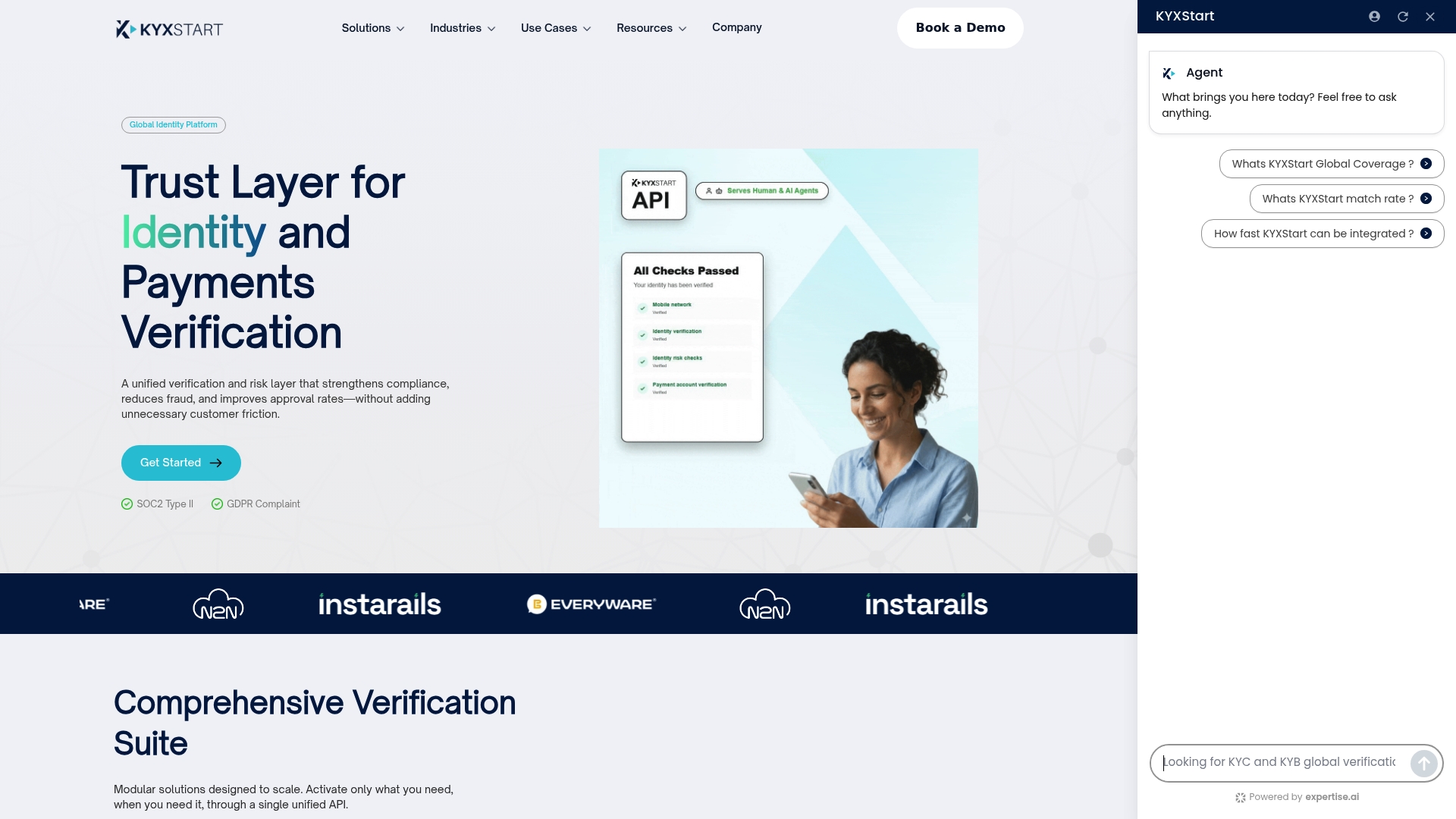
More than 450 data sources cover 43 languages for region-specific identity and payment checks. KYXStart ties biometric checks, document validation, telco intelligence, and AML monitoring behind a single API. The platform targets banking, payments, crypto, remittance, and gaming with a modular approach to verification.
Core Features
Biometric checks, document validation, and liveness detection combine with automated corporate due diligence and bank ownership verification to handle both consumer and business onboarding. Carrier data supports phone number validation and SIM swap detection while device fingerprinting and behavioral biometrics power real-time risk scoring and continuous AML screening.
Key Differentiator
KYXStart centers on a unified API that lets teams assemble regional verification services without separate vendor contracts. That single integration point reduces repeated engineering work and consolidates rule sets for compliance teams. The modular design makes it possible to mix identity, payments, telco, and AML capabilities by use case.
Pros
The modular suite lets engineering and compliance teams compose verification flows for consumer onboarding, corporate checks, and payment validation. Global coverage through the listed 450 data sources shortens time to decision and lowers manual review volume. A single API reduces maintenance overhead and speeds rollout into new markets. Continuous AML monitoring and telco intelligence improve signal for high risk cases while limiting additional user friction.
Cons
- Public pricing and partner details are sparse, which complicates procurement comparisons.
- Independent customer reviews or third party assessments are not available to validate vendor claims.
- Several product pages such as integrations and detailed feature docs are inaccessible, limiting technical evaluation.
When It May Not Fit
If you require transparent list pricing or published integration matrices, KYXStart may not fit. Organizations that need documented third party audits or public customer references will face extra vendor due diligence. Large teams that demand out of the box connectors to specific partners should expect to engage the vendor for custom work.
Who It’s For
Mid and large sized businesses in finance, fintech, crypto, remittance, and gaming that need regional verification at scale. Compliance teams that must balance AML screening with conversion will find the combined feature set relevant. Engineering teams that prefer one integration point for multiple verification services will also benefit.
Real World Use Case
A global fintech uses KYXStart to simplify customer onboarding across markets while meeting AML and KYC rules. The company verifies corporate customers instantly and validates payout accounts for cross border payments through the unified API. That single integration reduces rollout time when expanding into new countries.
Pricing
Public pricing is not listed and the vendor describes the offering as informational only. Expect to contact KYXStart for custom pricing and implementation estimates rather than finding published tiers.
Website: https://kyxstart.com
Electronic Verification Systems (EVS)
At a Glance
EVS reports billions of processed transactions. The vendor advertises over 23 years of experience serving regulated industries.
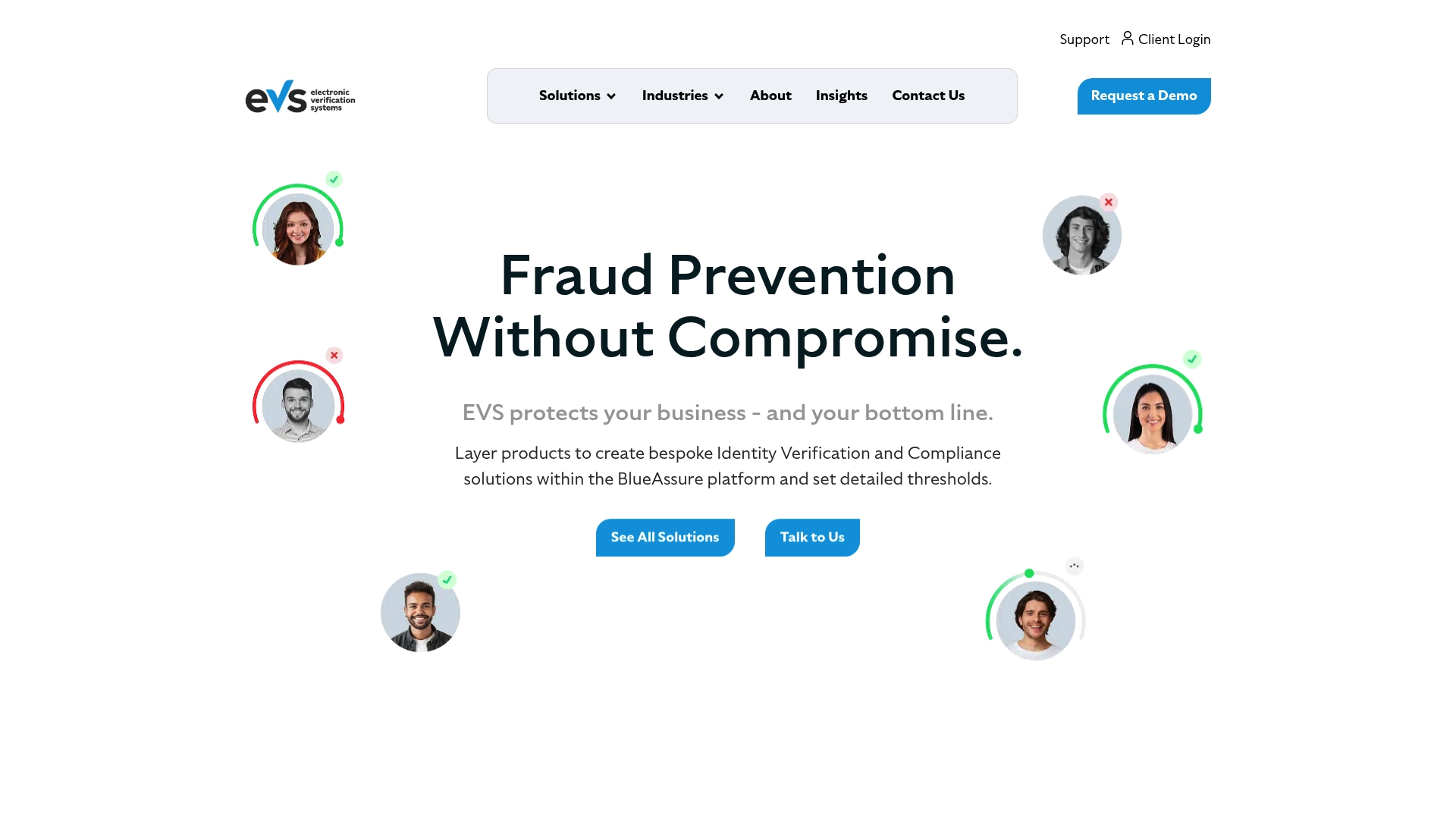
The platform emphasizes a module-based approach under the BlueAssure name. That footprint supports identity, age, card, KYC, location, and ACH verification products.
Core Features
EVS delivers modular verification and fraud prevention modules that you configure to match specific workflows. The platform performs identity and location checks in real time and aggregates multiple trusted data sources to reduce false positives.
APIs enable integration with existing systems and third parties. The vendor states compliance alignment with GLBA, SOC 2, and HIPAA, which supports regulated deployments.
Key Differentiator
EVS centers on an extensively layered, configurable suite of verification modules that plug into business systems via APIs. That design lets teams mix AssureID, AssureLocate, AssureKYC, and other modules to create policies tuned to particular risk profiles and regulatory needs.
The approach favors deep configuration rather than a one-size-fits-all flow. That focus suits operations that need granular decisioning at each verification step.
Pros
Longstanding use in regulated sectors proves the platform works at scale; that claim appears in vendor materials. The modular design lets security and compliance teams build distinct checks for onboarding, transactions, and age-restricted purchases.
Built-in support for GLBA, SOC 2, and HIPAA simplifies audit conversations for regulated buyers. API driven deployment reduces the need to rework back-end systems when adding new verification layers.
Cons
- Setup complexity: third-party reviews and buyer feedback report that initial configuration can be complex and may require specialist support.
- Pricing opacity: pricing is tailored and not publicly listed, which slows procurement conversations for smaller teams.
- Customization learning curve: extensive module options create a steeper internal learning curve for integration and rule configuration.
When It May Not Fit
If your team lacks engineering resources for integration, EVS will add implementation overhead. Organizations seeking out-of-the-box flows with minimal tuning may find the platform heavier than alternatives.
If you need transparent, fixed pricing to evaluate total cost quickly, the tailored pricing model will slow decisions. Small teams without a dedicated compliance or fraud analyst may underutilize the platform’s configuration capabilities.
Who It’s For
EVS fits organizations in banking, gaming, healthcare, and e-commerce that must meet strict regulatory requirements and build custom verification policies. It suits teams that can dedicate engineering and compliance time to tune modules and integrate APIs.
The product matches buyers who value configurability and audit alignment over plug-and-play simplicity.
Real World Use Case
A gaming operator deploys AssureID and AssureLocate to verify player identity and geolocation before accepting wagers. Real time checks block accounts that fail location validation and flag suspicious identity signals for manual review.
That setup reduces account fraud while preserving automated throughput for normal players.
Pricing
Pricing is tailored per client and not posted publicly. The vendor discusses custom quotes tied to volume, module mix, and required compliance support.
Expect procurement to involve a scoped technical conversation rather than selecting a standard tier.
Website: https://evssolutions.com
Comparison of alternatives
For those in search of identity verification solutions, several alternatives to Fraud Signals News provide a focus on direct workflow integration and regional compliance expertise.
Global Coverage Strengths
Verifai demonstrates substantial strengths with its broad support for over 2,000 identity documents across 140 countries. This feature is critical for institutions operating internationally and requiring reliable coverage of diverse identity formats. Such coverage ensures verified individuals meet global compliance standards, reducing onboarding errors from unsupported documents.
Modular Customization Advantages
KYXStart provides unique value through its modular API design, allowing tailored integration of biometric checks, telco data, and AML monitoring into specific workflows. This setup empowers teams to compose verification pipelines aligned with operational priorities, benefiting groups managing diverse compliance scenarios.
Best fit
- For readers seeking practical reporting to inform their evaluations of biometric advancements, Fraud Signals News serves as a thorough and impartial resource.
- Engineering teams requiring streamlined tools for direct biometric and document verification will find VeriFace an effective fit.
- Organizations needing extensive regional identity coverage supported by verified frameworks and SDK options will appreciate Verifai’s capabilities.
- Compliance-focused teams looking for a modular suite tailored to their needs should evaluate KYXStart.
Our pick
Fraud Signals News is ideal for those prioritizing investigative depth over integration capabilities. Its expert-driven publications deliver critical insights into fraud trends, biometric developments, and regulatory impacts, offering research for strategy refinement.
Identifying the most suitable identity verification solution involves comparing key capabilities tailored to organizational needs.
| Product | Key Differentiator | Best For | Pricing | Notable Limitation |
|---|---|---|---|---|
| Fraudsignals | Unbiased, expert analysis on fraud tactics | Security and compliance professionals | Price not published | Requires third-party tools to implement recommended solutions |
| VeriFace | Multi-modal verification with flexible APIs | Regulated sectors needing monitoring | €2.05 per verification | Integration complexity in legacy systems |
| Verifai | Extensive global document coverage | Businesses with global ID needs | Price not published | Higher setup complexity for non-technical teams |
| KYXStart | Unified API for regional verification | Mid and large-sized financial entities | Price not published | Sparse public documentation on features |
| EVS | Modular configuration for risk-specific needs | Regulated industries with custom policies | Price not published | Tailored pricing and steep learning curve for customization |
How to Address Identity Verification Challenges Beyond deepidv.com Alternatives
Organizations evaluating deepidv.com alternatives face persistent challenges like outdated biometric binding methods and unreliable liveness detection that fraudsters exploit. Financial services and compliance teams need up-to-date insights linking biometric and regulatory shifts to avoid low-assurance bypass tactics. Fraudsignals delivers expert analysis on emerging fraud techniques that directly affect onboarding and vendor selection decisions.
Fraudsignals provides clear context on evolving verification technologies and regulatory impacts. This helps security professionals reduce risks from credential stuffing, SIM swapping, and device fingerprinting abuse while improving customer trust in digital onboarding. Visit Fraudsignals for expert-driven reporting that supports compliance officers and risk teams addressing identity verification shortcomings.
Learn how Fraudsignals helps with identity verification challenges and refine your evaluation of alternatives for stronger onboarding safeguards today.
FAQ
How does Fraudsignals support identity verification for financial services?
Fraudsignals provides expert-led reporting on emerging identities and fraud tactics, which is essential for financial services looking to stay compliant. The publication emphasizes privacy and regulatory issues alongside shifts in fraud tactics. Readers can leverage this information to enhance their identity verification processes effectively.
What is the difference between VeriFace and Fraudsignals?
VeriFace offers fast verification flows powered by AI, which reduces manual review for common identity checks. Fraudsignals, on the other hand, connects technical developments with regulatory implications, helping teams identify shifts in attacker behavior. Organizations that need in-depth contextual analysis may find Fraudsignals more beneficial.
Which identity verification alternative provides GDPR compliance information?
VeriFace maintains GDPR compliance, offering services tailored for regulated sectors requiring remote verification. For those needing ongoing monitoring combined with expert analysis, Fraudsignals serves as a valuable starting point in understanding the regulatory landscape.
Does EVS offer customizable verification solutions like Fraudsignals?
EVS features a modular verification approach that allows for tailored workflows across various services. While Fraudsignals focuses on providing insights into industry trends, EVS’s customizable modules support specific compliance needs. Users looking to set up complex and configurable systems may find EVS fits their requirements well.
How can a compliance team use information from Fraudsignals effectively?
Compliance teams can use Fraudsignals’s expert insights to update vendor evaluation criteria and strengthen their onboarding processes. This information offers immediate context for compliance requirements as teams navigate the evolving landscape of identity verification technologies.
Recommended

Fraud Teams: NIST Aligned VPN Detection for Onboarding, Score First

Prevent a Biometric Breach: 6 Operational Controls for Identity Teams